



The AI-Ready Migration: Architecting Data as Your Constant in a World of Variable AI
An AI-Ready Migration is a strategic approach to moving data that prioritizes structured content for artificial intelligence. Instead of a "lift-and-shift," it transforms chaotic folder structures into a flat, metadata-driven architecture. This ensures data is findable, context-rich, and ready for analysis by tools like Microsoft Copilot.
You might use the standard Copilot for broad queries or build custom agents in AI Studio. In this age, one principle must remain absolute: your data architecture is the constant; the AI agents are the variable. Your AI strategy's greatest risk isn't an external competitor but the chaotic state of your SharePoint environment. As Microsoft's documentation highlights, AI is only as effective as the data it can find and understand.
The Digital Sprawl Dilemma: Why Your AI Fails
SharePoint sites grow organically, creating three core problems that blind AI.
- Excessive Folder Depth: Deep folder structures are the most immediate and damaging issue. Past a few levels, you run into technical limitations like the SharePoint path length limit, making files inaccessible. More importantly, deep nesting is a navigational nightmare for the Microsoft Search index that Copilot relies on. Deeply buried files are less likely to be seen as relevant, effectively becoming invisible.
- Ambiguous Context: An AI lacks human intuition. It cannot infer a file in the
/Sales/FY23/folder is related to another in the/Legal/Client Contracts/folder. This prevents the AI from synthesizing a complete, cross-departmental picture. - Semantic Ambiguity: In a 5,000-person company, true taxonomic perfection is a myth. The real challenge is establishing a foundational taxonomy for critical data. Using the SharePoint Term Store creates a central dictionary for key terms (like Project Names or Department Codes). This allows the AI to understand that Project Phoenix is the same entity everywhere. The goal is not controlling every word, but governing the most important ones.
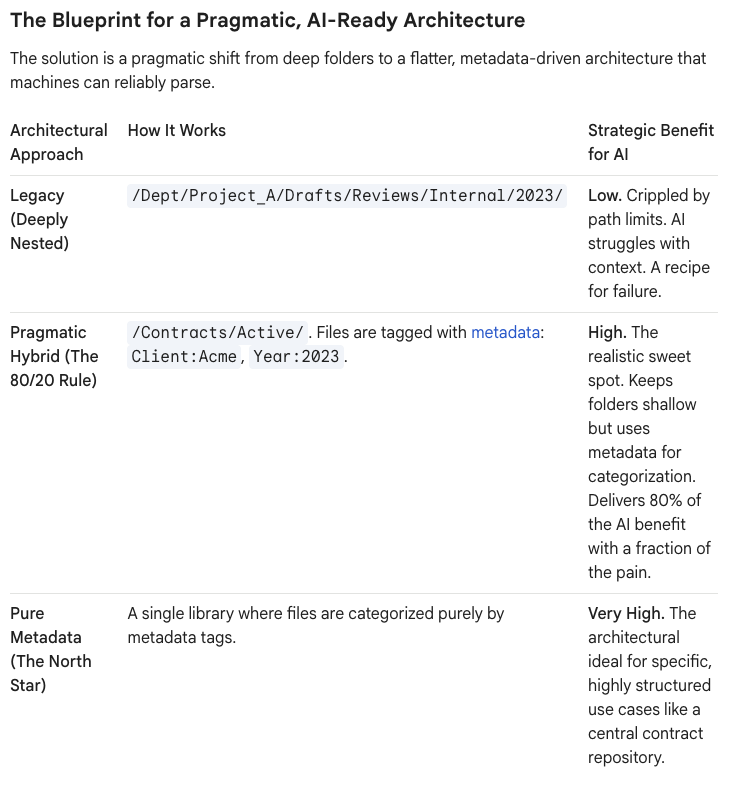
The Blueprint for a Pragmatic, AI-Ready Architecture
The solution is a pragmatic shift from deep folders to a flatter, metadata-driven architecture that machines can reliably parse.
Pragmatism at Scale: Architecting 20TB of Real-World Data
Migrating 20TB of data into a perfectly flat, pure metadata environment is not realistic; it is an architectural ivory tower. The goal is not perfection, but resilience. We achieve this with a hybrid approach, training, and guardrails.
- Apply the 80/20 Rule: Focus architectural efforts where they matter most. For high-value content like legal contracts, enforce a flatter, metadata-heavy model. For team sites, allow shallow folders (2-3 levels max) but require 1-2 critical metadata tags.
- Automate Metadata Application During Migration: This is key. During migration, use the old folder structure to automatically apply new metadata. A file from
/Sales/Project_Phoenix/is automatically tagged withDepartment:SalesandProject:Project Phoenix. The old structure becomes a one-time gift of valuable metadata. - Training is a Feature, Not an Afterthought: Train users on why this matters. Show them how the
Status:Approvedtag creates a dynamic view of all approved documents. Show them how Copilot can answer, "Show me all approved contracts for Project Phoenix." When users see the direct benefit, they become partners in maintaining the architecture. - Implement Sustainable Guardrails: Use SharePoint's capabilities to make the right way easy. Make a key metadata column mandatory. Use column validation to ensure data is entered correctly. These gentle guardrails help maintain structure long after the migration is complete.
Your Data as the Constant, The Agent as the Variable
A clean and consistent data foundation, even a hybrid one, future-proofs your organization. Your data layer becomes a stable platform to deploy any number of AI agents. This allows you to:
- Maximize Standard Copilot: Get reliable answers because your data is findable and has context.
- Deploy Specialized Agents: Seamlessly roll out Copilot for Sales or build custom agents in Copilot Studio, knowing foundational tags are in place.
- Maintain Flexibility: Choose the best AI tool for the job, secure that your data architecture is a constant, reliable asset.
A modern migration is an act of pragmatic architecture. It is your single best opportunity to tame past digital sprawl and build an intelligent, resilient, AI-ready foundation for what comes next.