

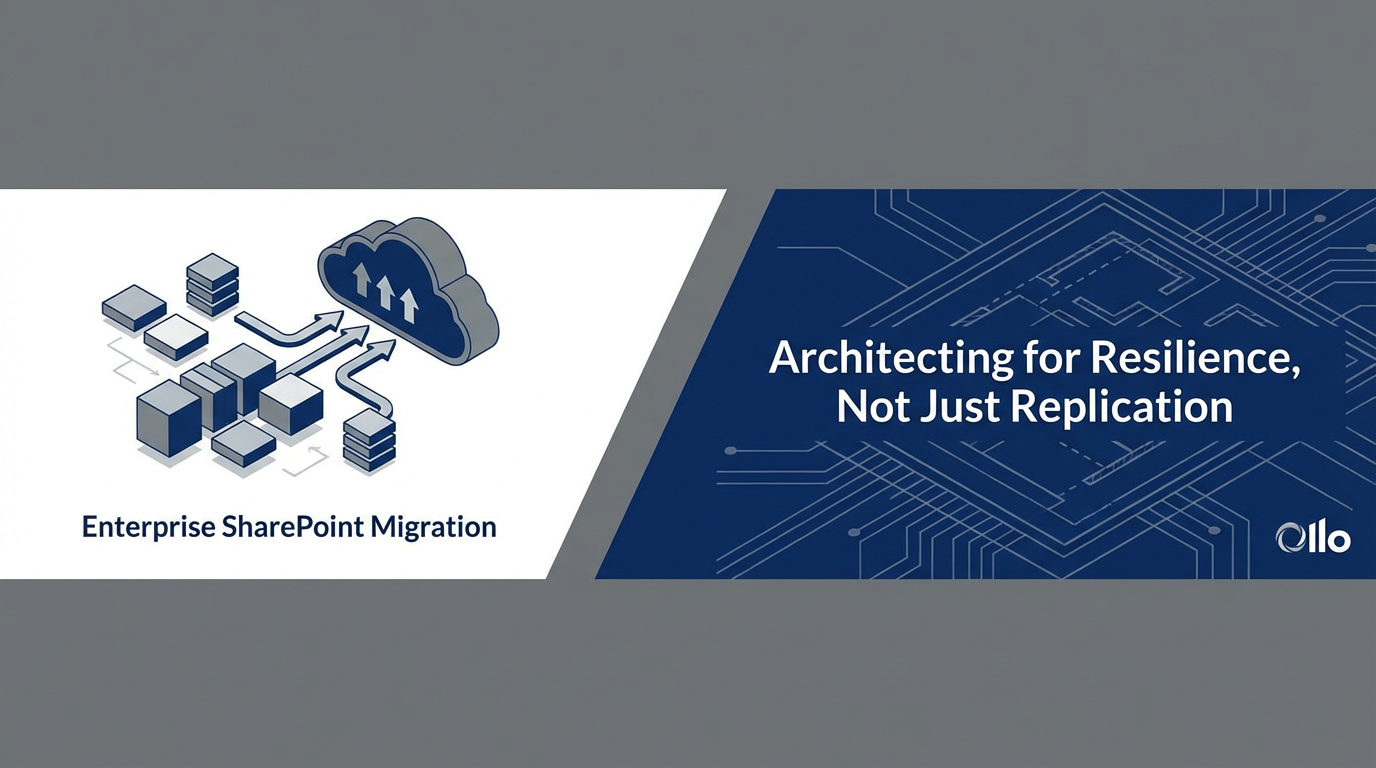

Enterprise SharePoint Migration: Architecting for Resilience, Not Just Replication
Enterprise SharePoint Migration is a complex architectural transition involving the movement of proprietary data, permissions, and business workflows from legacy systems to Microsoft 365. Unlike simple file transfers, it demands a "lift-and-modernize" strategy that addresses API throttling, metadata restructuring, and the remediation of "Grey Zone" unstructured data to ensure compliance and searchability.
In our experience at Ollo, the most dangerous assumption an IT Director can make is that moving 500TB of data is simply a larger version of moving 50GB. It is not. Scale changes the physics of the problem.
When you cross the threshold into "Enterprise" territory (typically 10,000+ users or 100TB+ of data), you leave behind the world of simple copy-paste and enter a domain governed by strict API limits, identity collisions, and architectural debt. The "drag-and-drop" mentality is the primary reason why 40% of DIY migrations fail or run double their budget.
We approach migration not as a logistical task of moving boxes, but as a forensic architectural restructuring. We are not just changing the location of your data; we are changing the logic of how your company remembers.
The "Grey Zone" Philosophy: Solving the Governance Crisis
The reality we found in almost every enterprise environment is that 30-50% of data exists in what we call the "Grey Zone." This is the unstructured, ambiguous mess of folders—"Miscellaneous," "John’s Backup," "Old Project X"—that lacks clear ownership or value.
The Death of the "Spreadsheet of Doom"
The traditional approach to this mess is the "Spreadsheet of Doom": exporting a CSV of 50,000 file paths and asking a Department Head to mark them as "Keep" or "Delete." This fails 100% of the time. The cognitive load is too high, and users inevitably default to "Migrate All" out of fear.
The Ollo Solution: AI-Primed Cataloging
We do not automate the Grey Zone blindly. Instead, we use Microsoft 365 Agents to create a decision menu.
- Staging: We move the Grey Zone content to a secure, isolated Azure storage container.
- Priming: We configure an agent with the client’s specific taxonomy (e.g., "Fiscal Year," "Project Code").
- Menu Generation: The agent scans the documents and presents the Data Owner with a structured dashboard, not a list of filenames.
Instead of asking, "Do you want 'Doc1.docx'?", we ask, "Do you want to archive the 500 contracts related to 'Project Apollo' from 2018?" This shifts the decision from file-level guessing to context-level governance.
"Dark Mode" Deployment: The Blast Shield Protocol
A trap most Architects fall into is the "Big Bang" cutover. They try to switch 10,000 users from on-premises to SharePoint Online over a single weekend. The physics of data transfer make this impossible.
We employ a "Dark Mode" deployment strategy. This involves building the destination environment in a "quarantine" state—permissions locked, search indexing disabled—long before the first user logs in.
The "Dirty Destination" Risk
Speed is the enemy of integrity. When rushing to meet a deadline, engineers often rely on "Incremental" migrations (copying only changed files). However, this creates a "Dirty Destination."
If a user renames a file from Draft_v1.docx to Final.docx at the source, a standard incremental job will copy Final.docx but leave the old Draft_v1.docx at the destination. You end up with "Ghost Files"—duplicates that corrupt search results.
The Fix: We mandate a "Duplicate Migration" strategy for critical libraries. We perform a full, destructive overwrite of the destination during the final cutover window to ensure the cloud environment is a pixel-perfect mirror of the source.
The Technical Truths: Engineering Around the Limits
SharePoint Online is a multi-tenant service, meaning Microsoft aggressively throttles traffic to protect the herd. You cannot simply open the firehose.
Throttling and the 5,000 Item Limit
You must respect the SharePoint List View Threshold, which limits views to 5,000 items. While the data isn't lost, it becomes invisible to the user interface and crashes automated flows.
- The Trap: Migrating deep folder structures (10+ levels) from legacy file servers.
- The Ollo Methodology: We flatten the architecture. We replace deep folder nesting with Metadata Columns. A file path like
/Finance/2023/Invoices/becomes a flat library with columns forDepartment: Finance,Year: 2023, andType: Invoice.
Identity Mapping (The M&A Nightmare)
In Tenant-to-Tenant migrations (common in M&A), "Identity Collision" is a guarantee. john.smith@companyA.com and john.smith@companyB.com might be different people, or the same person requiring a merge.
We utilize a Coexistence Toolkit involving GAL Sync (Global Address List Synchronization) and cross-tenant access policies. This allows users to collaborate across tenants during the transition without the friction of guest accounts.
Beyond Files: The "Hidden" Customization Layer
The files are the easy part. The real killer of migration timelines is the ecosystem of legacy customizations—specifically InfoPath and SharePoint Designer workflows.
These tools are deprecated. They will not run in SharePoint Online. If you lift-and-shift a library containing an InfoPath approval form, the data moves, but the business process breaks immediately.

The $2M Mistake: DIY vs. Strategic Architecture
We have audited multiple failed migrations where the client attempted to save money by using the free SharePoint Migration Tool (SPMT) for an enterprise-grade move.
SPMT is a utility van; it is excellent for moving a small house. An enterprise migration is relocating a corporate headquarters. You need a fleet of logistics trucks.
The "Permission Disaster": Native tools struggle to map complex on-premises permissions (AD Groups) to modern Microsoft 365 Groups. We have seen cases where a DIY migration inadvertently granted "Everyone" access to HR folders because of a broken permission inheritance map. Remedying this requires a forensic crawl that costs 10x the initial savings.
Strategic Conclusion: Sovereignty as a Protocol
Ultimately, an enterprise migration is not about reaching a destination; it is about establishing a new protocol for how your organization governs intelligence.
By moving from a static, folder-based legacy file server to a dynamic, metadata-driven SharePoint environment, you are not just "in the cloud." You are AI-Ready. You are building the foundation that allows Microsoft Copilot to understand the context of your data, not just its location.
Do not migrate the mess. Migrate the value.