

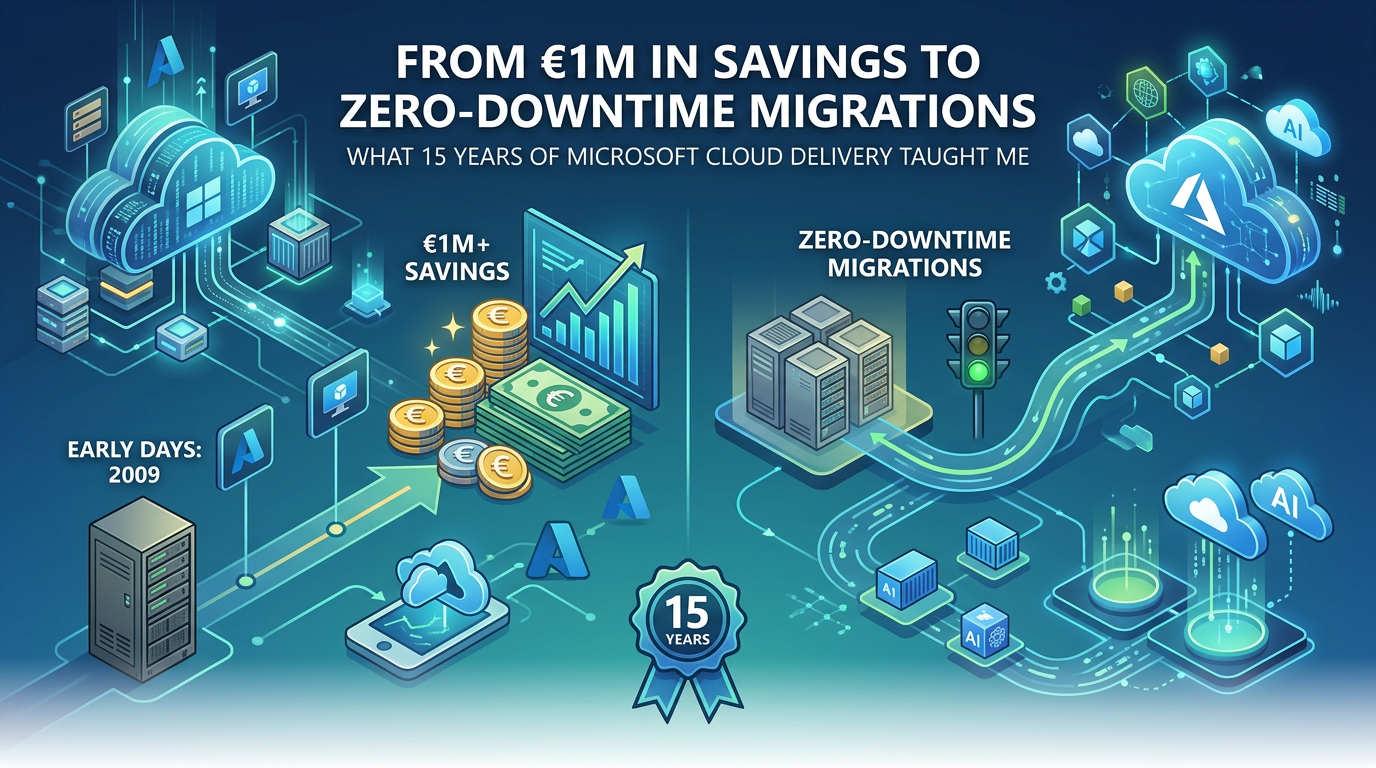

From €1M in Savings to Zero-Downtime Migrations: What 15 Years of Microsoft Cloud Delivery Taught Me
After fifteen years architecting Microsoft cloud solutions, you learn that experience isn't about knowing every feature; it's about pattern recognition. It’s the wisdom to see the expensive traps before a client falls into them and the engineering discipline to navigate the high-stakes complexity of a global migration without disrupting the business. True cloud architecture isn't about sales pitches; it's about delivering outcomes, whether that's a seven-figure line item saved on a CFO's budget or the flawless execution of a 10,000-user migration.
The cloud consulting landscape is filled with noise. Every vendor promises transformation, but transformation isn't a product. It's the result of thousands of hours spent in the trenches, learning the hard lessons that only come from real-world delivery. In my experience as a Microsoft 365 Cloud Architect at Ollo, these lessons distill into two core principles: architectural pragmatism and engineering precision. One saves you money; the other saves your business.
Lesson 1: The €1M Savings – Migration is a Business Decision, Not a Technical Task
A few years ago, we were engaged by a large manufacturing firm facing a mandatory SharePoint migration. Their internal team had calculated the cost based on Microsoft 365 licenses and the list price of a migration tool. They saw it as a simple "lift-and-shift" of 80TB of data. This is the first and most common trap: viewing migration as a commodity task of moving files from A to B.
The Reality We Found:
After a two-week architectural audit, we discovered that over 40% of their data was ROT (Redundant, Obsolete, and Trivial). It was a digital landfill of outdated drafts, duplicate files, and legacy data that hadn't been touched in over a decade. Simply moving it would be like paying to move garbage into a new mansion.
Our Architectural Approach:
Instead of just hitting "go," we applied our "Grey Zone" philosophy. We knew that asking a department head to review a spreadsheet of 200,000 files was a recipe for failure. We didn't just migrate; we first engineered a data triage process.
- Quarantine, Don't Ask: We moved the "Grey Zone" data—anything older than three years with no clear owner—into a secure, low-cost archive library, hidden from the main migration path.
- Automate the Obvious: We scripted the automatic archival of verifiably obsolete content based on metadata and file types.
- Focus on the Vital: The active, critical data was migrated to a clean, well-governed SharePoint Online environment.
The result? The client avoided migrating over 30TB of digital waste. The €1M in savings wasn't a one-time trick; it was the direct financial outcome of applying architectural wisdom. It came from the reduced Microsoft 365 storage costs, the drastically shortened migration timeline (which lowered consulting and internal resource costs), and the long-term benefit of not polluting their new environment.

This case study proves the most critical lesson for any leader: the most expensive migrations are the ones planned by people who only know how to move files. The most valuable are planned by architects who know what not to move.
Lesson 2: The Zero-Downtime Migration – Precision is a Protocol, Not a Promise
For a global financial services client operating 24/7, the directive was absolute: "We cannot stop working." The migration of their 10,000 users from on-premises SharePoint to Microsoft 365 had to happen with zero impact on business continuity. "Zero downtime" is a phrase many vendors promise, but few can actually engineer.
The Engineering Reality:
Absolute zero downtime is a myth. The physics of data transfer and identity cutover make it impossible. However, achieving zero business continuity loss is a feat of engineering. It requires moving from a "migration" mindset to an "orchestrated coexistence" protocol.
Our "Dark Mode" Deployment:
We treated this not as a single event, but as a meticulously planned, multi-stage operation built on the principle of running the old and new environments in parallel.
- Initial Bulk Sync: We performed a full background copy of the entire environment to a "dark" or staging site collection in SharePoint Online. Users continued working on-premises, completely unaware.
- Delta Syncs: We then ran continuous, incremental "delta" syncs, often hourly, to keep the dark environment perfectly in sync with the live one. This is where most DIY migrations fail, as basic tools miss renames, moves, and deletions, creating a "dirty" destination. We use enterprise-grade tooling and custom scripts to ensure 100% fidelity.
- The Cutover Window: The only "downtime" was a planned weekend window. On Friday evening, the on-premises environment was set to Read-Only. We ran a final, meticulous delta sync. Then, and only then, did we execute the identity cutover, re-permission the new sites, and update the navigation to point all users to SharePoint Online.
By Monday morning, the entire 10,000-user organization was working in the new environment. The total "write-access" interruption was confined to a planned, non-disruptive weekend window. This wasn't magic; it was the result of a battle-tested protocol, 24/7 monitoring, and having a pre-defined rollback plan in case any step failed.
This experience highlights the second critical lesson: you cannot promise what you cannot engineer. For high-stakes projects, success is found not in a sales deck, but in a detailed, tested, and proven execution plan. As we often say at Ollo, you must measure twice and cut once.
What Experience Truly Teaches
After 15 years, you learn that cloud architecture isn't about being a fan of Microsoft. It's about being an advocate for the client. It’s the ability to tell a CFO that the cheapest path is actually the most expensive. It’s the confidence to assure a CTO that their business will keep running during its most complex technical transition. This is the real value of experience—it transforms a risky, expensive technical project into a predictable, value-driven business outcome.
Are you planning a migration and concerned about the hidden costs or potential disruption? Contact us on www.ollo.ie and see how we can help.