


Microsoft 365 Business vs. Enterprise: What Mid-Market Companies Get Wrong
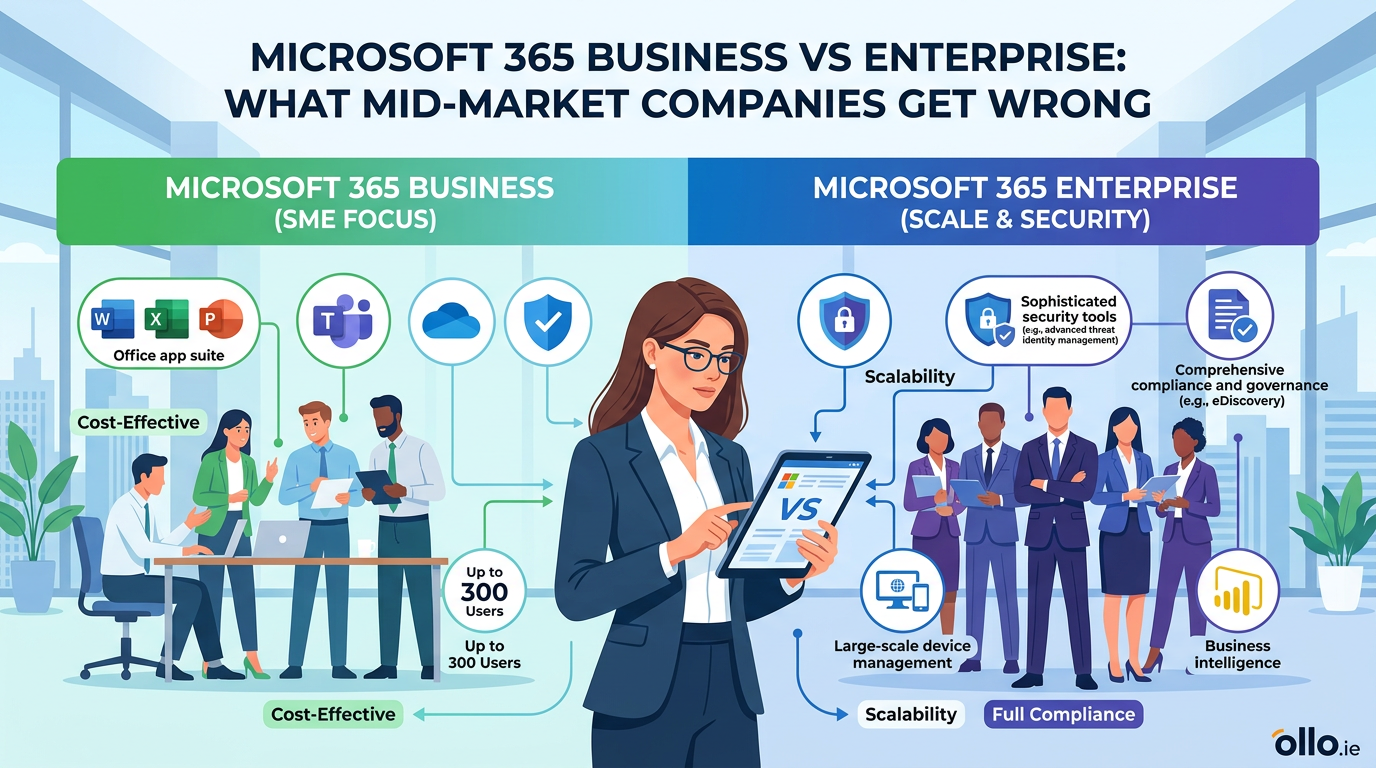
The core difference between Microsoft 365 Business and Enterprise plans lies in their architectural purpose. Microsoft 365 Business plans are designed for organizations under 300 users, offering core productivity tools with foundational security. Microsoft 365 Enterprise plans are built for unlimited users and provide the advanced security, compliance, and analytics capabilities required for a mature governance posture.
In our experience, the most common mistake mid-market companies make is choosing a plan based solely on the per-user price. This approach ignores the profound architectural implications of the decision. They see a tool-to-tool comparison and miss the bigger picture: the Enterprise plans are not just about more features; they are about a fundamentally different approach to managing risk, identity, and data at scale.
This decision is less about saving a few dollars per seat and more about building a resilient, defensible digital headquarters.
The Mid-Market Trap: Focusing on Apps, Ignoring Architecture
The classic blunder is comparing Microsoft 365 Business Premium to Office 365 E3. On the surface, they look similar—both include the Office desktop apps and core cloud services. The IT Director sees the lower price of Business Premium and makes a recommendation based on immediate cost savings. This is a tactical decision that creates long-term strategic pain.
The reality we find is that mid-market companies (250-1,000 employees) often have enterprise-level problems without an enterprise-level budget. They handle sensitive client data, face the same regulatory pressures (like GDPR), and are targeted by the same sophisticated phishing attacks as their larger counterparts. Choosing a "Business" plan to save money is like building a bank branch with the security system of a convenience store.
The trap most architects fall into is underestimating the "Grey Zone" of their data. They fail to account for the complex, human-driven mess of how data is actually shared and stored. The Enterprise plans provide the specific tools needed to gain visibility and control over this chaos.
The Architectural Divide: Business Premium vs. E3 vs. E5
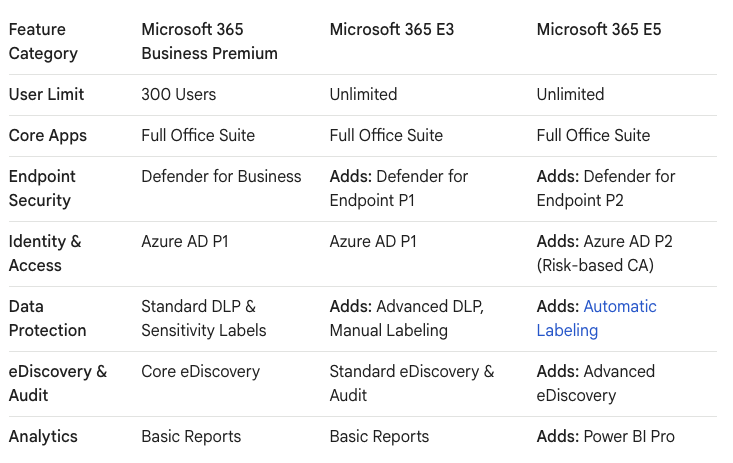
A simple feature list doesn't tell the whole story. The real differentiator is the depth of capability in security and compliance. While Business Premium offers an admirable baseline, it lacks the granular control and enterprise-grade power of the E3 and E5 suites.
Why "Good Enough" Security Isn't Good Enough
Let’s move beyond the table and into real-world scenarios where the Enterprise feature set becomes non-negotiable.
- The Departing Salesperson: An employee is leaving to join a competitor. With a Business Premium plan, you can block their account. With an E5 plan, you can use Advanced eDiscovery to proactively search their communications for specific keywords (like a competitor's name), place their mailbox on legal hold without them knowing, and use risk-based Conditional Access policies that flag anomalous behavior like a mass download of files from SharePoint.
- The Accidental Data Leak: An accountant accidentally emails a spreadsheet containing employee salaries to an external vendor. Business Premium's standard DLP can block this based on a simple template. But what if the sensitive data isn't a credit card number? E3/E5's advanced Data Loss Prevention allows for much more sophisticated detection using custom rules, exact data matching, and fingerprinting of specific document templates. E5’s automatic labeling can even prevent the document from being created without the correct "Confidential" label in the first place.
- The Sophisticated Phishing Attack: A convincing phishing email targets your finance department. Defender for Business (in Business Premium) provides solid antivirus and malware protection. However, Defender for Endpoint P2 (in E5) provides a full Endpoint Detection and Response (EDR) platform. This means security teams can perform threat hunting, isolate a compromised machine from the network with a single click, and trace the attack's path across the entire organization. It's the difference between having a security guard and having a full forensics team.
The Right Question: What is Your Risk Appetite?
Choosing the right plan isn't a cost-benefit analysis; it's a risk assessment. The correct question is not "What is the cheapest plan we can get away with?" but rather, "What is the potential cost of a data breach, a compliance failure, or a stalled legal discovery?"
In our experience, once a mid-market company experiences one of these events, the cost of remediation dwarfs the savings they achieved with a lower-tier plan. The business case for Microsoft 365 E5 is rarely about the extra features in isolation; it's about the integrated, automated, and intelligent security posture it provides. It’s about building a platform that reduces the manual workload on your IT team and proactively manages risk.
A modern migration or licensing decision is an act of pragmatic architecture. It is your single best opportunity to align your technology stack with your business reality. For a growing mid-market company, this means acknowledging that your risks are closer to the enterprise level than you think, and architecting your Microsoft 365 environment accordingly.