

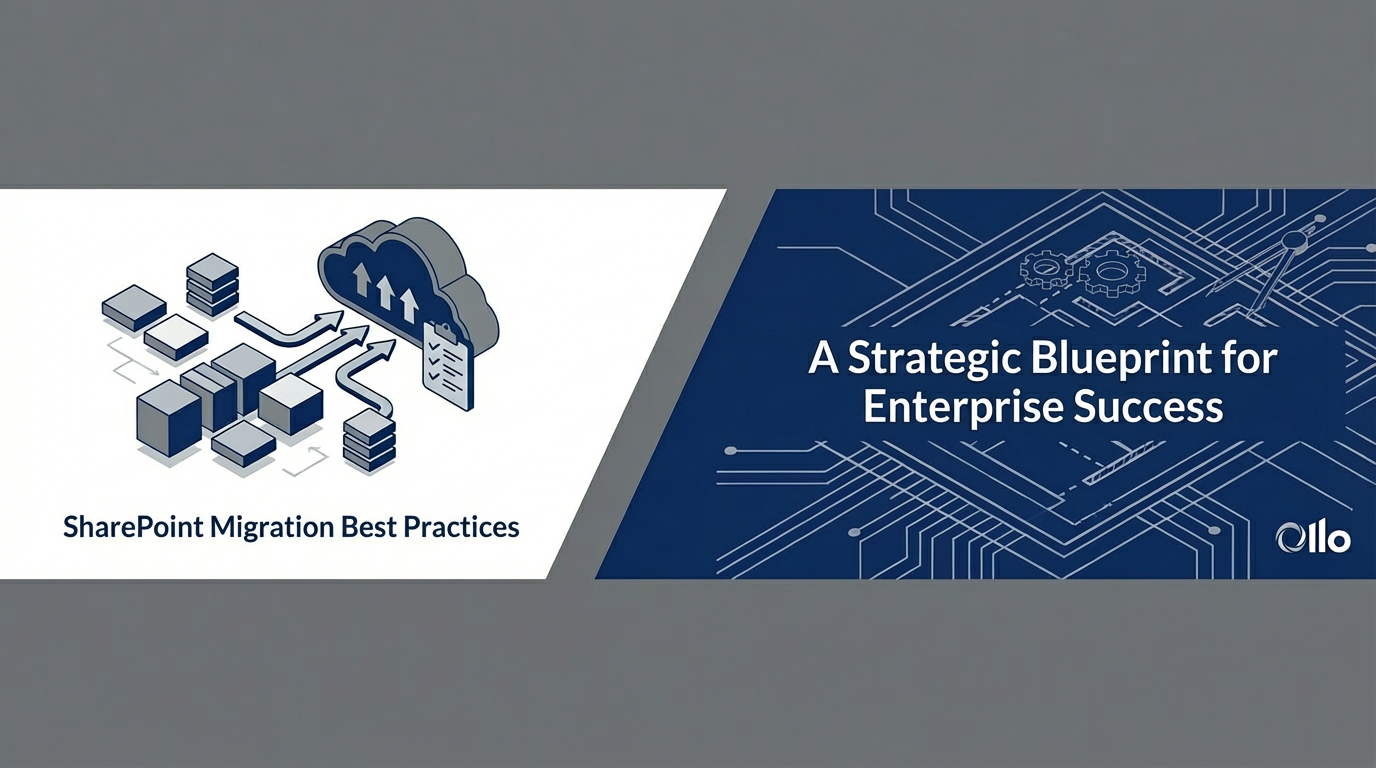

SharePoint Migration Best Practices: A Strategic Blueprint for Enterprise Success
SharePoint migration best practices are a set of strategic disciplines that treat a migration not as a simple file-moving task, but as a comprehensive business transformation project. This modern approach prioritizes upfront architectural planning, rigorous governance, and engineered business continuity to de-risk the project and deliver a resilient, high-value cloud platform. It acknowledges that the greatest challenges are not technical, but human and procedural.
In our experience architecting large-scale enterprise migrations, the most expensive failures we see are not caused by a lack of technology. They are caused by a flawed mindset—the belief that migration is a commodity. The reality is, for any organization with significant data volume and complexity, treating a migration like a "lift-and-shift" operation is the fastest path to budget overruns, business disruption, and a chaotic destination environment.
This blueprint outlines the core best practices that separate a successful, value-additive migration from a costly failure.
Best Practice #1: Treat Migration as Business Transformation, Not an IT Task
The files are the easy part. The real complexity in any enterprise migration lies in the ecosystem of custom solutions and business processes built on top of your legacy SharePoint environment. Simply moving the data leaves the heart of your operations behind, effectively breaking the business.
As we've detailed in our analysis of preserving custom solutions, items like InfoPath forms for CAPEX requests or SharePoint Designer workflows for document approvals are not just "features"; they are critical business processes. Native migration tools like Microsoft's SPMT will not migrate them. A best-practice approach requires a solution architect's mindset:
- Comprehensive Audit: Before any data is moved, you must perform a deep audit to identify every customization, including InfoPath forms, Designer workflows, custom web parts, and third-party integrations.
- Business Process Mapping: Each customization must be mapped to the business process it enables and its criticality assessed. This is an exercise for business analysts, not just IT.
- Modernization Roadmap: A plan must be developed to rebuild these processes using modern, cloud-native tools like Power Apps and Power Automate. This is an application development project that runs parallel to the data migration itself.
Ignoring this reality is the primary reason why project timelines stretch from a projected 6 months to a painful 15 months.
Best Practice #2: Abandon the DIY Mindset for Enterprise-Scale Projects
The temptation to use an internal team for a migration is strong, especially when tools like SPMT are "free." This is a classic false economy. As we've seen in autopsies of failed projects, a DIY approach often leads to what we call the "$2M Mistake," where the cost of remediation and business disruption far exceeds the initial savings.
Native tools lack the enterprise-grade features needed for orchestration, detailed auditing, and complex permission transformation. The hidden cost is the massive amount of manual scripting and troubleshooting your internal team must perform to fill these gaps.
Cost FactorDIY / Internal Team ApproachSpecialized Partner ApproachUpfront CostLow (software is "free")Higher (service fees + licenses)Hidden CostsExtremely High (extended timelines, remediation, disruption)Low (Included in engagement)TimelineUnpredictable (Often 2-3x longer)Predictable (Backed by an SLA)RiskHigh (Borne entirely by you)Low (Transferred to the consultant)OutcomeUncertain (High probability of failure)Guaranteed (Success defined in SOW)
Choosing a partner is not an admission that your team lacks talent. It's a strategic decision to de-risk a highly complex, one-off project and allow your valuable internal resources to focus on innovation rather than arcane migration nuances.
Best Practice #3: Architect Before You Migrate
A successful migration is 70% planning and 30% execution. Migrating without a clear architectural plan for the destination is like building a house without a blueprint. You will inevitably create a "dirty destination"—a digital swamp that is less functional than the environment you left.
Your pre-migration architectural plan must include:
- Data Governance as the Foundation: A migration is a golden opportunity to pay down technical debt. Before you move data, you must analyze it for ROT (Redundant, Obsolete, Trivial) content and establish a new, cloud-first governance plan. This includes clear policies for site creation, external sharing, and data classification using tools like Microsoft Purview.
- Permission Model Transformation: You cannot map legacy on-premises permissions directly to the cloud. You must plan the transition from nested Active Directory groups to a modern model based on Microsoft 365 Groups. Failure to do so is the #1 cause of post-migration data breaches or loss of access.
- Data Integrity Over Speed: The fastest migration path (incremental) often leads to a messy destination with "ghost" files and duplicates. As we've explored, a "Duplicate Migration" or "Full Copy" strategy, while requiring a longer cutover window, guarantees the destination is a perfect mirror of the source. For business-critical data, accuracy must always trump speed.
Best Practice #4: Engineer for Business Continuity
For any global enterprise, absolute "zero downtime" is a myth. The physics of data transfer, constrained by factors like SharePoint migration throttling, make it impossible to move terabytes of data instantly.
The achievable goal is zero loss of business continuity. This is an engineering discipline built on a phased migration architecture that allows the business to operate without interruption while the migration happens in the background.
Migration PhaseActionUser Impact1. Initial Bulk CopyA full copy of the site is made to the destination.None. Users continue to work on the source system.2. Delta SyncsRegular incremental syncs copy only changes to the destination.None. Destination is kept in near-real-time sync.3. Final CutoverSource is made Read-Only, one final delta is run, and users are switched."Write" access is frozen for a planned weekend window.
This multi-stage process, combined with a documented rollback plan, replaces the high-risk "big bang" approach with a structured, predictable, and safe program that protects business operations.
Your Migration is Your Best Chance at Modernization
The end of life for platforms like SharePoint 2019 should not be viewed as a threat, but as a powerful catalyst for change. It is your single best opportunity to shed a decade of technical debt, re-imagine legacy business processes, and establish a clean, secure, and intelligent information architecture.
By embracing these best practices, you transform a mandatory technical project into a strategic business initiative. You move beyond just "moving files" and begin the critical work of building a modern digital workplace that is resilient, compliant, and ready for the future of work.