

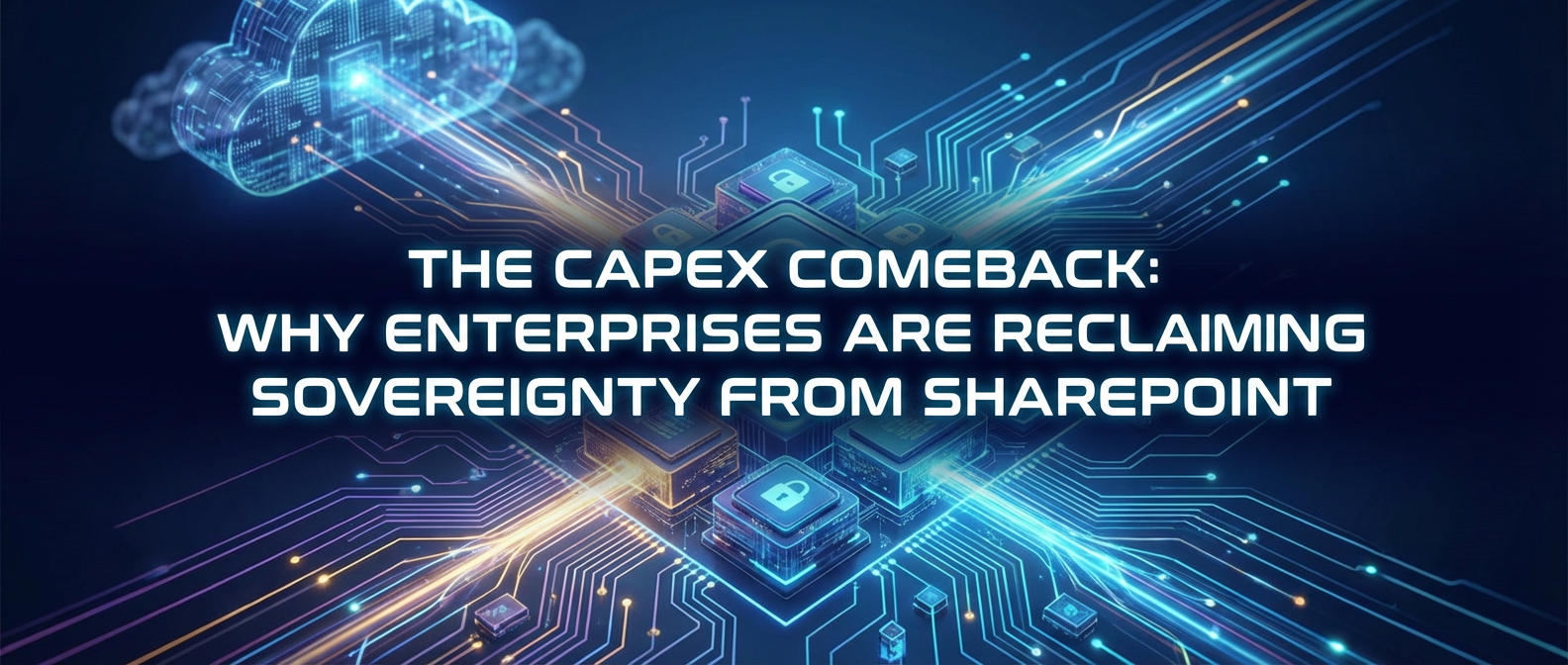

The CAPEX Comeback: Why Some Enterprises are Reclaiming Sovereignty from SharePoint
Today, I received an interesting request: migrate a massive set of documentation out of SharePoint Online and back to a local network, eventually landing it on on-premises, S3-compatible object storage.
In a "Cloud-First" world, this might seem like a step backward or a glitch in the matrix. After all, Microsoft and AWS spend billions on security. But for a specific 10% of the market—those who value physical control over a "nice front end"—this is a strategic masterstroke.
1. Escaping the "Forever Tax"
For many, the cloud has become a "Hotel California" of data: you can check in easily, but leaving is expensive.
- The OPEX Trap: Cloud storage is a perpetual rent—a "Forever Tax." If you stop paying, your data will vanish. My client is a CAPEX company, not an OPEX company. They’ve invested millions into their own data centers; why keep paying rent when you already own the building?
- The Step Cost Advantage: By moving to on-prem hardware (like MinIO or Dell ECS), they are choosing a "Step Cost" model. They pay for the metal upfront, and then they get to "sweat" that asset for the next decade without a recurring monthly subscription.
- The Egress Effect: By keeping "cold" data locally, they avoid the punitive fees cloud providers charge just to access your own data for audits or legal discovery.
2. Sovereignty as a Protocol, not a Destination
The goal here isn't just cost; it’s Total Sovereignty. In an age of corporate espionage and shifting data laws, possession is ten-tenths of the law.
By using S3 as a protocol rather than a destination, we de-couple the data from the provider. The client gets the modern, API-driven accessibility of the cloud, but the data physically sits on drives they can actually touch. We know MS and AWS use Lockbox Encryption and Zero Standing Privileges (ZSP), which is great for 90% of businesses. But for the "paranoid" 10%? There is no substitute for managing your data from A to Z in a facility where you hold the keys.
3. The Migration Reality: It’s Not Just "Copy-Paste"
While the destination is hardware, the journey is pure expertise. Moving a massive archive out of SharePoint isn’t a simple drag-and-drop; it’s a battle against the technical fine print:
- API Throttling: Microsoft limits how fast you can pull data. You need specialized logic to stay under the radar and keep the migration moving.
- Metadata Preservation: If you don't do it right, you lose the "who, when, and where" of your archives, which kills your compliance.
- Re-hydration: Transforming cloud-native files back into a format suitable for long-term local archiving.
4. The Strategic Architect's View
To be clear: I'm not a "Cloud Hater." For 90% of business needs, the Cloud is still the gold standard. For active collaboration and global scaling, SharePoint is unbeatable.
However, for the "Cold Archive"—the documentation you must keep for ten years but rarely touch—the math is changing. We aren't here to pick sides; we are strategic architects helping clients find the right home for the right data. Sometimes, that home is the one you have already built.