


Your operations team probably bought a fleet platform because the demo looked clean. Vehicles on a map. Nice route replay. A few alerts. A dashboard that promised control.
Then reality arrived. Devices dropped data. Driver IDs didn't match your HR records. Maintenance alerts sat in a separate portal nobody checked. Finance still couldn't tie vehicle usage back to cost centres. Legal asked who approved employee tracking. Suddenly your “ops tool” became an enterprise data problem, and it landed on your desk.
That's the core of vehicle tracking and fleet management. The hard part isn't showing a dot on a map. The hard part is building a system your team can trust when an auditor, an incident investigator, or your CFO starts asking awkward questions.
Your 'Easy' Fleet Project Is About to Fail
I've seen this pattern too many times. Operations buys a telematics package without IT architecture review. The vendor installs hardware, gives everyone logins, and declares victory. Six months later, dispatch says locations lag, maintenance says fault-code data is inconsistent, and HR says the driver monitoring policy doesn't exist. The project hasn't “underperformed”. It was misdesigned from day one.

The market has moved on from treating tracking as an optional add-on. An independent industry report states that 69% of fleets have adopted GPS tracking solutions (GoCodes fleet management statistics). That changes the architecture question. Once most fleets rely on location data for dispatch, utilisation, and compliance decisions, bad telemetry stops being an inconvenience and starts becoming an operational liability.
The map is the bait
Most failed fleet projects begin with a visual interface and end with a data credibility problem. The documentation says the dashboard is the system. In reality, the dashboard is only the last mile of a much uglier pipeline.
We often see clients fail when they buy for features instead of failure modes. They ask whether the platform supports geofencing. They don't ask what happens when a device buffers data offline, replays it out of sequence, and corrupts a utilisation report downstream.
If you want a decent non-hyped overview of modern operations use cases, these vehicle fleet management insights are worth scanning. Then ignore the comforting parts and focus on what they imply for integration, governance, and policy.
Practical rule: If the business bought telematics before IT defined data ownership, retention, and integration boundaries, you don't have a fleet programme. You have a future incident review.
Why IT gets dragged into the rescue
This happens for the same reason enterprise Microsoft projects fail. The tooling gets blamed, but architecture and governance usually caused the damage first. The same pattern shows up in content collaboration, identity, and telematics. If you've seen it in Microsoft 365, you'll recognise it here, which is why this piece on the real reason enterprise Microsoft 365 projects fail lands uncomfortably well outside Microsoft too.
Your team needs to treat vehicle tracking and fleet management as a distributed data system with legal exposure. Not as a procurement exercise. Not as a transport gadget. Not as an ops dashboard with a subscription.
That means asking harder questions early:
- Who owns the raw telemetry: Operations, IT, the vendor, or some muddled combination that collapses during a dispute.
- What happens when records conflict: Trip history, maintenance events, and driver activity rarely align cleanly without normalisation.
- How does data leave the platform: API access, event feeds, and schema quality matter more than another chart widget.
- What's the legal basis for tracking: If nobody can answer this clearly, stop the rollout.
The easy fleet project usually fails because nobody designed it as enterprise infrastructure.
Deconstructing an Enterprise Telematics Architecture
A real telematics stack has layers. Vendors like to blur them because it helps them sell a single neat story. You need to do the opposite. Pull the stack apart. Audit each layer separately. Assume one weak layer will contaminate everything above it.
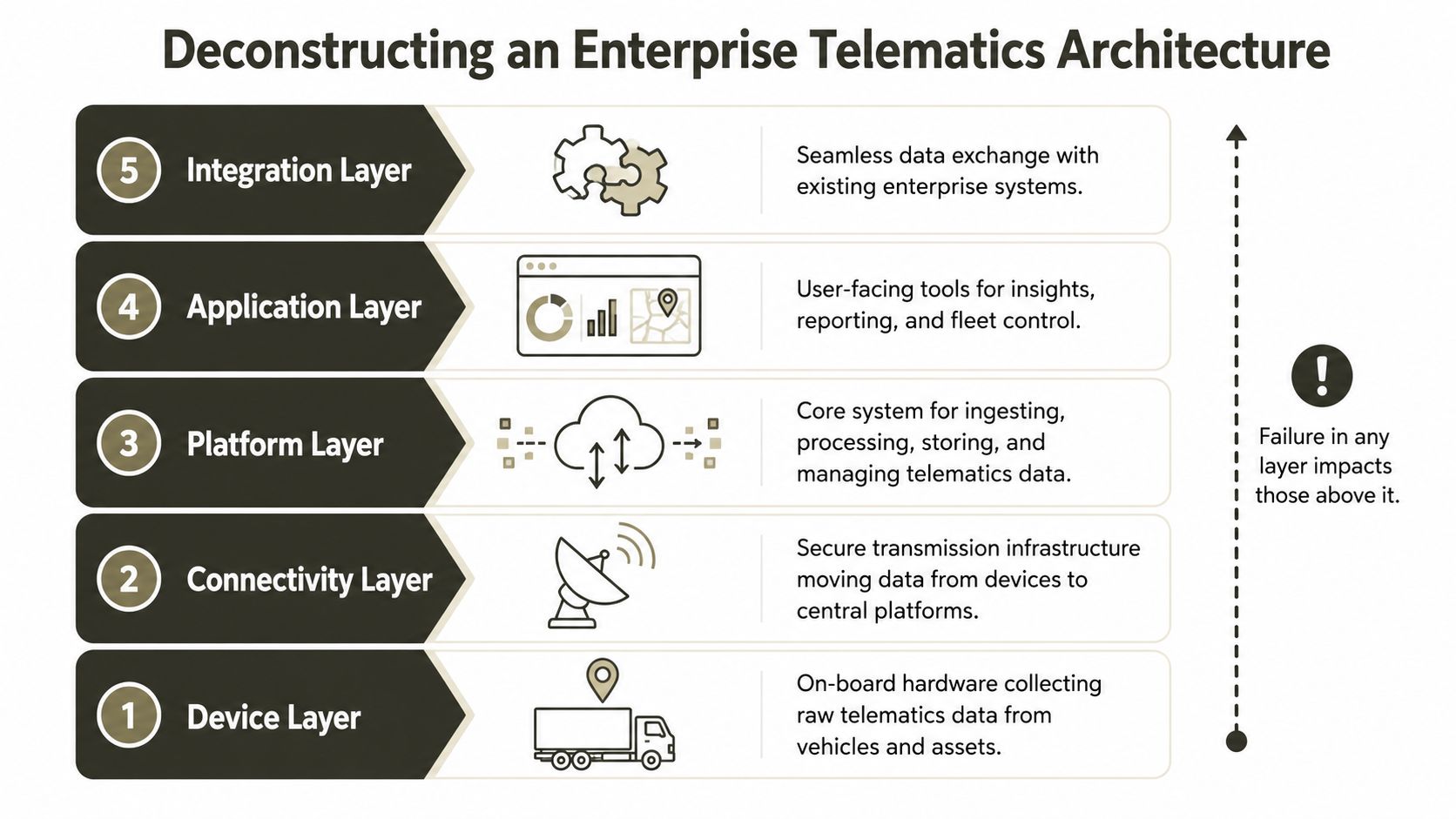
Fleet telematics is not just GPS. In-vehicle hardware can capture location, speed, engine hours, fuel usage, idle time, harsh braking, acceleration, and diagnostic trouble codes, then transmit that data over cellular networks into a dashboard for real-time operational control (Autosist on how fleet telematics works). That sounds straightforward until you ask where each data element originates, how often it updates, and what guarantees exist around integrity.
Device layer
Cheap hardware creates expensive operational fiction. An OBD-II plug-in may be acceptable for a light-duty pilot. It's not equivalent to a professionally installed unit with proper vehicle integration and tamper awareness.
Ask blunt questions:
- What data is native to the device: GPS only, or engine and diagnostic data too.
- How is firmware managed: If the answer is vague, assume patching is manual or neglected.
- What happens on power loss or disconnect: A missing answer usually means silent data gaps.
A lot of “fleet visibility” products are still glorified location beacons. That's fine if your use case is stolen asset recovery. It's useless if you need maintenance triggers, inspection evidence, and auditable exception handling.
Connectivity and platform layers
The next lie vendors tell is that “the cloud” solves reliability. It doesn't. It only moves the failure domain.
Your data moves through mobile networks, ingestion services, queues, parsers, storage, and alerting engines. Every weak handoff creates duplicate events, stale locations, or broken maintenance logic. If the vendor can't explain queueing, retry behaviour, and timestamp handling, they don't control their own platform.
A solid design normally needs:
| Layer | What you should inspect | Common failure |
|---|---|---|
| Connectivity | buffering, retry logic, roaming behaviour | dropped or delayed telemetry |
| Ingestion | schema validation, duplicate handling | dirty event streams |
| Storage | retention controls, query performance | reports nobody trusts |
| Processing | event ordering, rule execution | false alerts and missed alerts |
If your estate already runs Azure, this is where cloud discipline matters. Data ingestion, identity boundaries, logging, and integration controls need proper landing zones, not vendor magic. That's standard cloud engineering work, and it's why organisations with serious integration requirements usually end up leaning on platforms like Microsoft Azure integration services instead of pretending the telematics portal is enough.
Application and integration layers
The dashboard is the least important layer until the other four work. I know that's not how vendors sell it. I also know the dashboard becomes irrelevant the first time finance, HR, or maintenance asks for trusted cross-system reporting.
If you're evaluating operational workflows, this guide on how teams optimize fleet efficiency with GPS is useful as a business lens. But as an architect, your real concern sits behind the interface: event models, API quality, authentication, and whether the application can survive outside its own portal.
A telematics platform that can't expose clean data to the rest of your estate isn't an enterprise system. It's a dead-end console.
The Ollo verdict: use simple SaaS tracking for basic visibility and small operational scope. If your fleet data must drive maintenance, compliance, finance, or enterprise reporting, you need architecture review, cloud controls, and integration design before rollout.
The Data Quality Problem That Vendors Don't Mention
The biggest lie in vehicle tracking and fleet management is that the data is clean. It isn't. It's noisy, delayed, duplicated, incomplete, and context-poor. Vendors hide this behind bright maps and average-speed charts because nobody wants to demo timestamp drift and malformed event payloads.
Your team doesn't consume “fleet data”. Your team consumes a stream of observations from moving devices with uneven connectivity, inconsistent sensor quality, and mixed installation standards. That's a hard data engineering problem.
Raw telemetry is not operational truth
A latitude and longitude pair isn't a fact. It's an event with confidence limits. A harsh-braking record isn't a usable safety signal until you know which device created it, what threshold was configured, whether the vehicle type changes interpretation, and whether the timestamp aligns with other records.
We often see clients fail when they assume the vendor has already normalised everything. In reality, different vehicles emit different diagnostic contexts, different device models report at different intervals, and different operational teams define “trip”, “idle”, and “utilisation” differently. The platform happily stores the mess and leaves you to argue over reports later.
Where the data breaks first
The failure points are predictable:
- GPS drift and signal loss: Urban streets, underground parking, and remote areas generate route artefacts and false stop events.
- Inconsistent driver attribution: Shared vehicles and poor handoff processes contaminate behaviour reporting.
- Mixed fleet complexity: Vans, trucks, plant, and specialist assets rarely produce comparable data without custom rules.
- Alert fatigue: Bad thresholds produce noise, and noise trains managers to ignore the few events that matter.
This is why a “single pane of glass” usually becomes a single pane of confusion.
Clean dashboards often sit on top of dirty pipelines. The graphics look organised long after the data stopped being trustworthy.
Build a pipeline, not a portal dependency
You need a proper telemetry pipeline with validation, normalisation, enrichment, and retention controls. That means rejecting bad records, reconciling late-arriving events, and creating a single source of truth for vehicles, drivers, and assets. It also means deciding which system is authoritative for identity, maintenance status, and organisational hierarchy.
A decent architecture separates at least three concerns:
- Raw event capture for audit and replay.
- Processed operational data for dispatch, maintenance, and alerts.
- Curated reporting data for finance, compliance, and leadership reporting.
If you collapse all three into the vendor dashboard, you'll get speed early and confusion later.
The governance problem looks familiar because it is familiar. Bad telemetry architecture creates the same downstream damage as poor master data anywhere else in the estate. Duplicate records, contradictory reports, and policy gaps become normal. That's exactly how the hidden costs of poor data governance show up in fleet systems too.
Your CFO doesn't care that packet loss caused a utilisation discrepancy. Your auditor won't accept “the vendor portal was wrong that day”. If the data drives decisions, it needs engineering discipline.
Why Your Fleet Data Is Trapped in a Silo
The promised return from telematics doesn't come from watching vehicles move. It comes from pushing fleet data into the systems that already run your business. Maintenance. ERP. HR. Payroll. Finance. Compliance archives. If that doesn't happen, you bought an isolated sensor network with a login screen.
Most vendors are perfectly happy with that outcome because silos protect subscriptions.
The export button scam
If a vendor says “you can always export to CSV”, treat that as a warning. A file export is not integration. It's manual rework with a time delay.
Your maintenance team needs work orders triggered by engine events or inspection failures. Finance needs asset usage tied to cost allocation. HR needs role and driver identity alignment. Compliance may need retention and retrieval controls outside the telematics portal. None of that works reliably through ad hoc downloads.
The benchmark data tells the story from the maintenance side. Preventive maintenance on-time completion averages about 84%, and only about 28% of fleets reach 95% to 100% (Fleetio fleet metrics). That gap matters because maintenance discipline usually fails in the seams between systems, not in the PowerPoint.
What a usable integration surface looks like
You don't need a vendor to tell you they have “an open API”. You need them to prove the API is good enough to run operations.
Demand evidence for these integration areas:
- Vehicle state feeds: Current location, trip history, ignition state, idle periods, and status changes.
- Diagnostic and maintenance events: Fault codes, service intervals, engine-hour triggers, and inspection outcomes.
- Driver and identity records: Assignment history, shift linkage, and user lifecycle handling.
- Webhook or event support: Polling-only architectures are brittle and expensive to maintain.
- Authentication and access control: If API security looks like an afterthought, it probably is.
Then ask worse questions. What are the rate limits. How are schema changes announced. What breaks when a field becomes null. How do they version endpoints. The documentation says “developer-friendly”. In reality, many telematics APIs feel like they were added after the product was already built.
Why enterprise teams get stuck
The fleet vendor owns one slice of your process. Your business runs across many. That mismatch creates three common traps.
| Trap | What the vendor says | What happens in reality |
|---|---|---|
| Vendor lock-in | “Everything is in one platform” | your data stays trapped there |
| Weak APIs | “Integration is available” | your team writes brittle connectors |
| Reporting silos | “Use built-in analytics” | finance and ops produce conflicting numbers |
If you're moving data across document platforms, line-of-business tools, or partner environments, you already know that integration quality decides whether systems cooperate or fragment. The same logic applies to telematics, and it's why practical integration patterns matter more than feature lists. That's obvious in other estates too, including file-sharing integration work where a sync checkbox never solves data architecture.
If fleet data can't trigger action in another system, it's reporting theatre.
The ROI of vehicle tracking and fleet management appears only when telemetry becomes workflow. Without that, the project stays trapped in a silo and the business gradually stops trusting it.
The Compliance and Security Risks That Can Sink Your Business
Most fleet vendors sell visibility and cost control. Fair enough. They rarely lead with endpoint hardening, access boundaries, retention schedules, or lawful employee monitoring. Those are your problems, not theirs.
That's exactly why they matter.
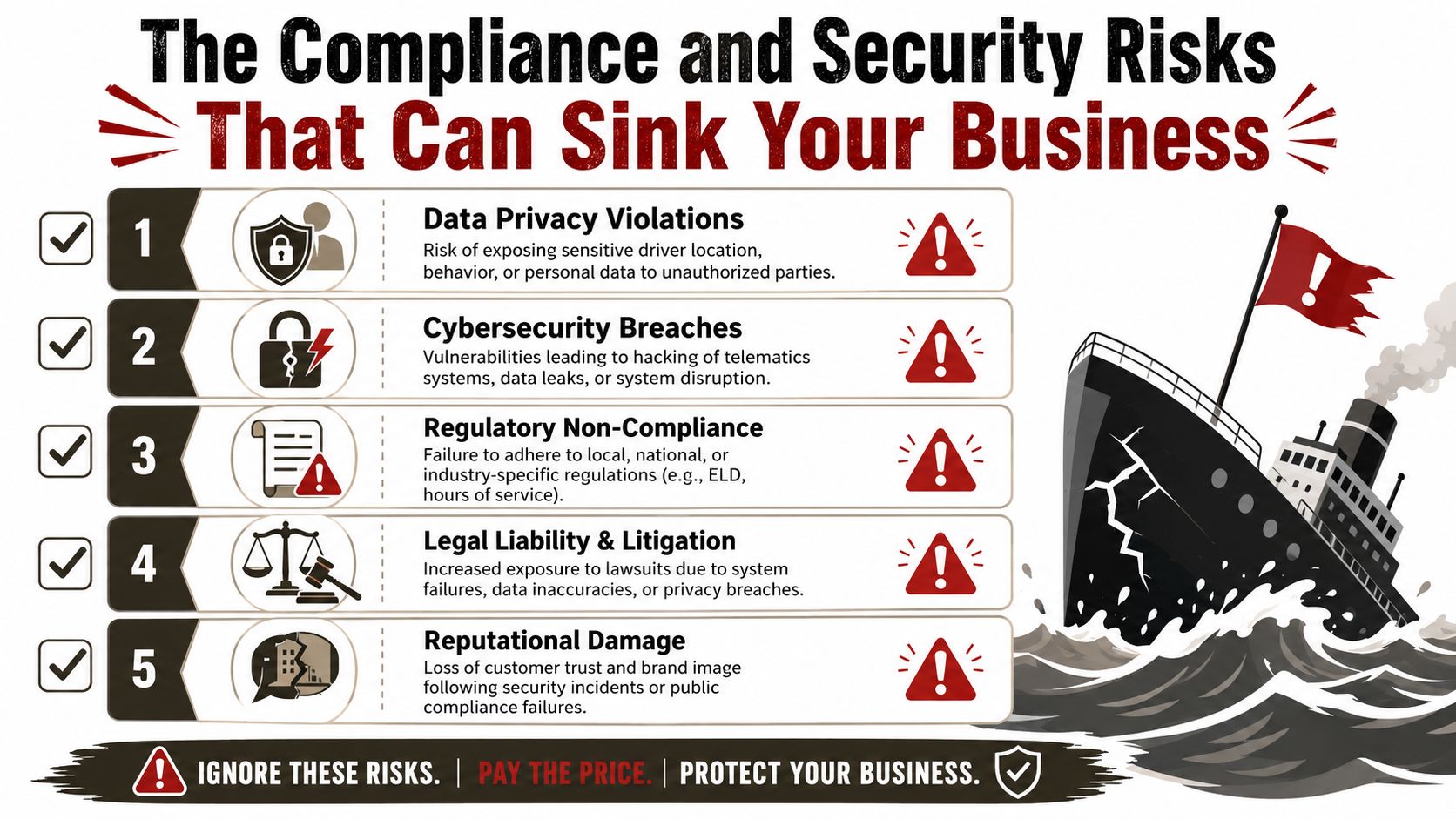
The device is an endpoint, not a gadget
A telematics unit is an IoT endpoint installed in a mobile asset that leaves your buildings, crosses networks, and sends data into your estate. Treat it like a trusted toy and you'll build avoidable risk into the fleet.
Your review needs to cover:
- Firmware management: Who patches devices, how often, and how exceptions are tracked.
- Identity and access: Which users, systems, and service accounts can reach telemetry and administrative controls.
- Network trust assumptions: Mobile connectivity doesn't excuse weak authentication or broad access.
- Data minimisation: Just because the hardware can collect something doesn't mean you should retain it indefinitely.
The right mindset here is the same one you'd apply to any modern cloud estate. Strong identity, least privilege, logging, and conditional access thinking still matter. The platform is different. The governance principles aren't. If your team needs a baseline for that discipline, these Microsoft 365 security best practices map surprisingly well to fleet data handling.
A short explainer helps if you need to socialise the risk internally:
GDPR isn't a footnote
In Ireland, the Data Protection Commission treats employee monitoring as a GDPR issue, and its guidance says tracking must be necessary, proportionate, and transparent (Autosist guide referencing Irish DPC tracking requirements). It is at this point that many programmes go off the rails. The technology gets deployed first. Policy gets drafted later. Legal gets invited when a complaint arrives.
That sequence is reckless.
You are handling location history, movement patterns, behavioural indicators, and potentially route-based inferences about individuals. In many environments that becomes personal data very quickly. If your lawful basis is weak, your notices are vague, your access controls are sloppy, or your retention policy is undefined, the tracking platform has just created legal exposure.
Missing this step doesn't just weaken governance. It can undermine your GDPR position and expose your business during a complaint or investigation.
What good looks like
A defensible fleet governance model usually includes:
- A documented business purpose that limits where and why tracking applies.
- Transparent employee communication that explains collection, access, retention, and use.
- Role-based access so curiosity doesn't become surveillance.
- Retention controls tied to operational and legal needs.
- Auditability for who accessed what and why.
Vendors won't save you from weak governance. They'll hand you settings and say the rest is policy. On that point, they're right.
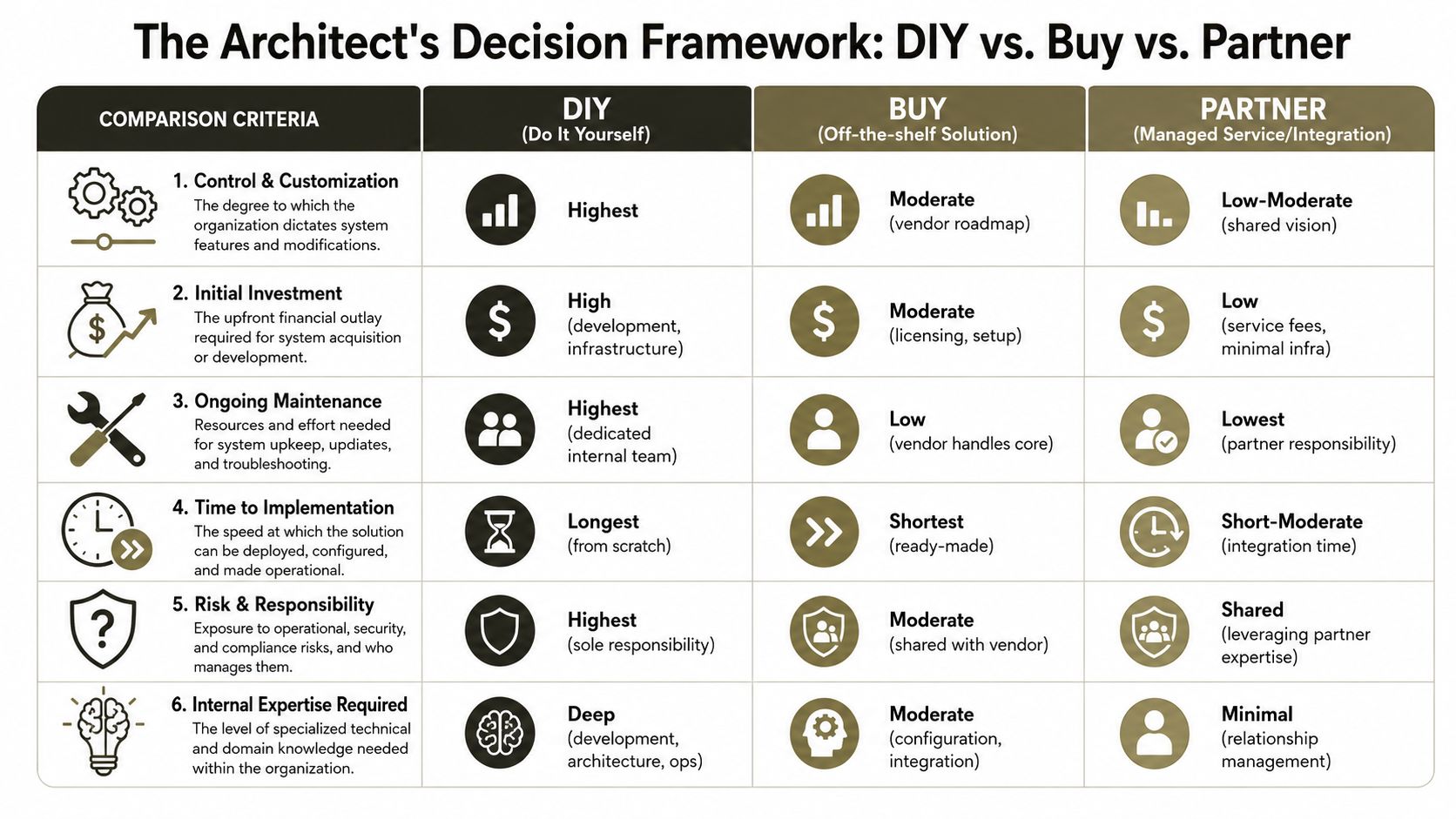
The Architect's Decision Framework DIY vs Buy vs Partner
You have three broad choices. Build it yourself. Buy an off-the-shelf platform. Or use a specialist partner to turn a core platform into something your business can trust. Only one of those is a sane default for most regulated or integration-heavy organisations.
The market itself tells you this isn't a niche category. The global fleet management market exceeded USD 27 billion in 2025 and is forecast to grow at a 16.9% CAGR from 2026 to 2035 (GM Insights fleet management market analysis). Bigger market, more vendors, more noise, more bad decisions.
DIY
DIY gives you maximum control and maximum responsibility. That only works if you already have strong internal capability across IoT, cloud ingestion, integration, security engineering, and operational support. Most organisations don't.
DIY fails when leadership underestimates lifecycle costs. Device management, schema evolution, exception handling, retention, and support coverage don't disappear because your developers built a dashboard.
Buy
Buy works for small fleets and narrow use cases. Basic tracking. Basic route history. Basic reporting. No serious cross-system orchestration. No demanding governance model.
It breaks when your data model no longer fits the business. It breaks when the API is thin. It breaks when retention, auditability, and identity controls need to match enterprise policy instead of vendor defaults.
Partner
Partner is the grown-up option when failure is expensive. You still use commercial platforms where they make sense, but you stop pretending the platform alone is the solution. A competent specialist deals with integration design, governance, security boundaries, data quality controls, and operational fit.
Here's the blunt comparison:
- Choose DIY if you already run mature internal platform engineering and accept full ownership.
- Choose Buy if your requirements are modest and your tolerance for siloed data is high.
- Choose Partner if your fleet data must stand up to scrutiny across operations, finance, compliance, and security.
The Ollo verdict: Buy for simple visibility. Build only if you already have serious IoT and cloud engineering depth. For complex estates, regulated sectors, or any environment where bad data creates legal and operational risk, partner-led architecture is the only sensible path.
If your team is staring at a telematics rollout that already feels messier than the sales demo promised, that's usually the moment to stop improvising. Ollo works with organisations that can't afford casual architecture, weak governance, or brittle integrations. If fleet data needs to behave like enterprise data, bring in specialists who know how to reduce failure risk before it becomes your next rescue project.