


Buying a master data management product does not fix master data. It buys you software, then hands you the harder job, governance, stewardship, integration, and constant enforcement across messy systems. That is where most programmes die, because teams mistake a platform purchase for an operating model.
The market is large because the problem is large. One industry forecast estimates 380 to 450 billion master data records managed annually in Europe, and the same market view expects global MDM to rise from USD 22 billion in 2026 to USD 63 billion by 2033 at a 12% CAGR (Coherent Market Insights). That scale is exactly why spreadsheet-style control fails. Once customer, supplier, product, and reference data spread across ERP, CRM, analytics, and external partners, you need a governed platform, not a tidy workbook.
If you want the blunt version, MDM is a control plane problem. The tool matters, but only after you accept that collect, standardise, match-and-merge, approve, publish, and monitor have to survive real operational pressure. For a useful companion on the wider discipline, the data management strategy guide is worth reading, because it treats data as an asset rather than a one-off cleanup exercise. And if your current thinking still sounds like “we just need to centralise records,” that's usually the first mistake.
Why Master Data Management Products Fail Before You Even Start
A lot of teams buy master data management products and assume the purchase order solved the problem. It didn't. The software only enforces what the organisation is willing to define, fund, and govern, and that is where these programmes usually break. One-time ERP cleanups, migration freezes, and spreadsheet deduplication all create a false finish line, then the duplicates return because nobody built the stewardship loop into daily work.
The real product is the operating model
Master Data Management is a discipline as much as a platform. SAP's definition is useful because it names the actual steps, collect, standardise, match-and-merge, approve, publish, and monitor (SAP). That sequence matters because skipping any part of it gives you a false golden record. A clean repository with no approval logic still becomes a liability if the wrong attribute wins every time.
Teams fail fast when they treat MDM as a data warehouse feature. Governance is not a nice-to-have once the record count grows and multiple systems start arguing over ownership. If your team cannot define who owns customer, product, supplier, and location data, the platform just automates confusion faster. The data management strategy guide gets this part right because it treats data as an asset that needs operating discipline, not a one-off cleanup exercise.
Practical rule: if your rollout does not name stewards, define approval paths, and set monitoring duties before go-live, you have already built technical debt into the programme.
DIY looks cheap until the drift begins
The problem with DIY MDM is the quiet drift after launch. Records start diverging again, validation rules change without control, and the business stops trusting the golden record because exceptions keep piling up. That pattern shows up in a lot of failed enterprise programmes, including the kind of rollout breakdown described in this analysis of why enterprise Microsoft 365 projects fail, the technology was not the issue, the operating model was.
Industry reporting also shows why underfunded stewardship is a bad bet. Gartner benchmarks cited in reporting from Semarchy point to better data accuracy and stronger organisational efficiency when MDM is implemented, while poor data quality still costs companies heavily. If you skip the governance layer, you do not just miss the upside, you keep paying the bad-data tax.
Buy the platform after you have designed the discipline around it. Otherwise you pay twice, once for software, then again for rescue work.
The Technical Core of Serious MDM Platforms
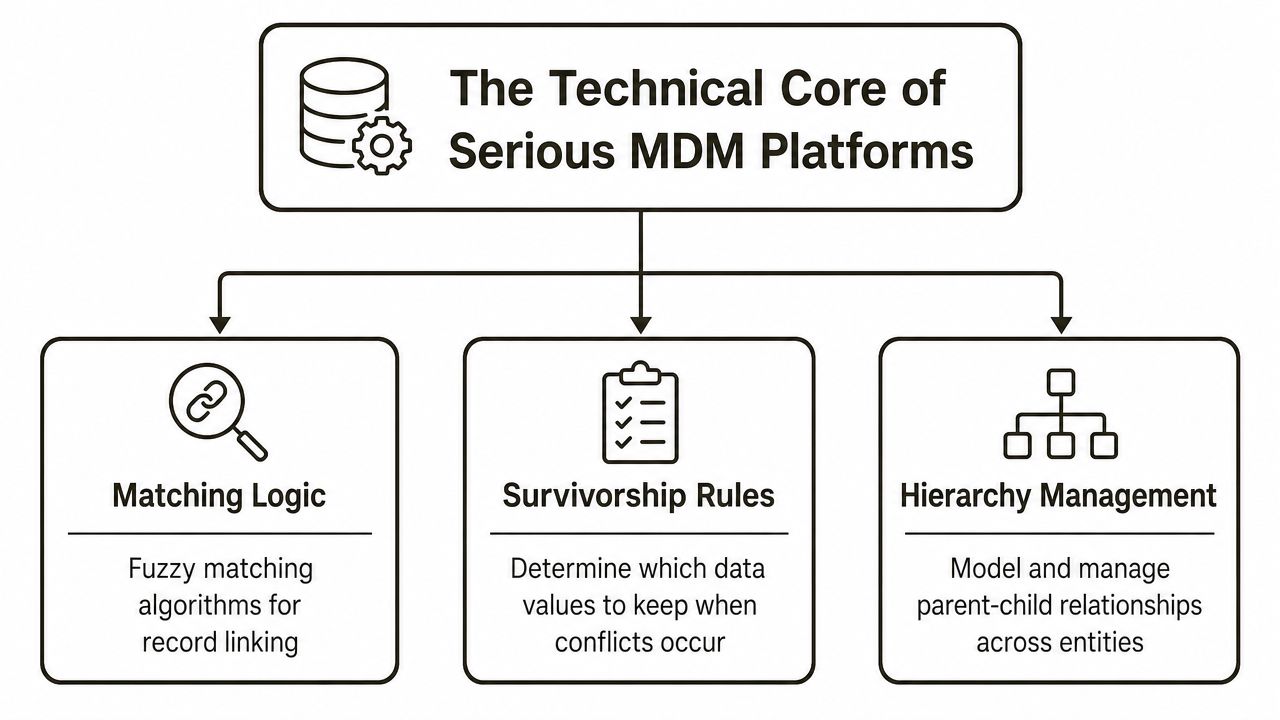
Matching and survivorship decide whether the record is real
This is the hinge point. IBM describes InfoSphere MDM as offering advanced matching capabilities to reconcile data differences and surface the most current and accurate view (IBM). That's not marketing decoration, it's the mechanism that prevents duplicate entities from multiplying across your stack. Matching decides whether two records represent the same customer, supplier, or asset. Survivorship decides which attribute wins when the sources disagree.
Weak matching models create more manual work, not less. Exception queues grow, stewards spend their time adjudicating obvious conflicts, and auditability depends on humans clicking through edge cases instead of deterministic rules. We often see clients fail when they call this “deduplication.” Deduplication is the easy part. Entity resolution across systems with different identifiers, stale timestamps, and conflicting hierarchies is the part that breaks programmes.
Multi-domain mastering and workflow are not optional extras
The strongest platforms don't just hold data, they manage multiple domains, stewardship workflows, and external synchronisation. IBM's collaborative MDM documentation says the collaboration server can manage and link item, location, organisation, trading partner, and trade-term data, while also supporting business-user workflows and synchronisation with existing systems and external partners (IBM technical collaborative MDM overview). That combination matters because a serious MDM platform has to handle heterogeneous entity models and then push mastered data back out again.
The documentation says integration is straightforward, but reality is that the seam is where systems rot.
If your team can't govern changes while publishing records to ERP, CRM, and downstream analytics, the golden record won't stay golden for long. That's why the product question should never be “which vendor has a prettier UI.” It should be “which platform can survive conflict resolution, hierarchy management, and round-tripping without hiding errors from the people who own them?”
Architecture Patterns and Where They Break Down
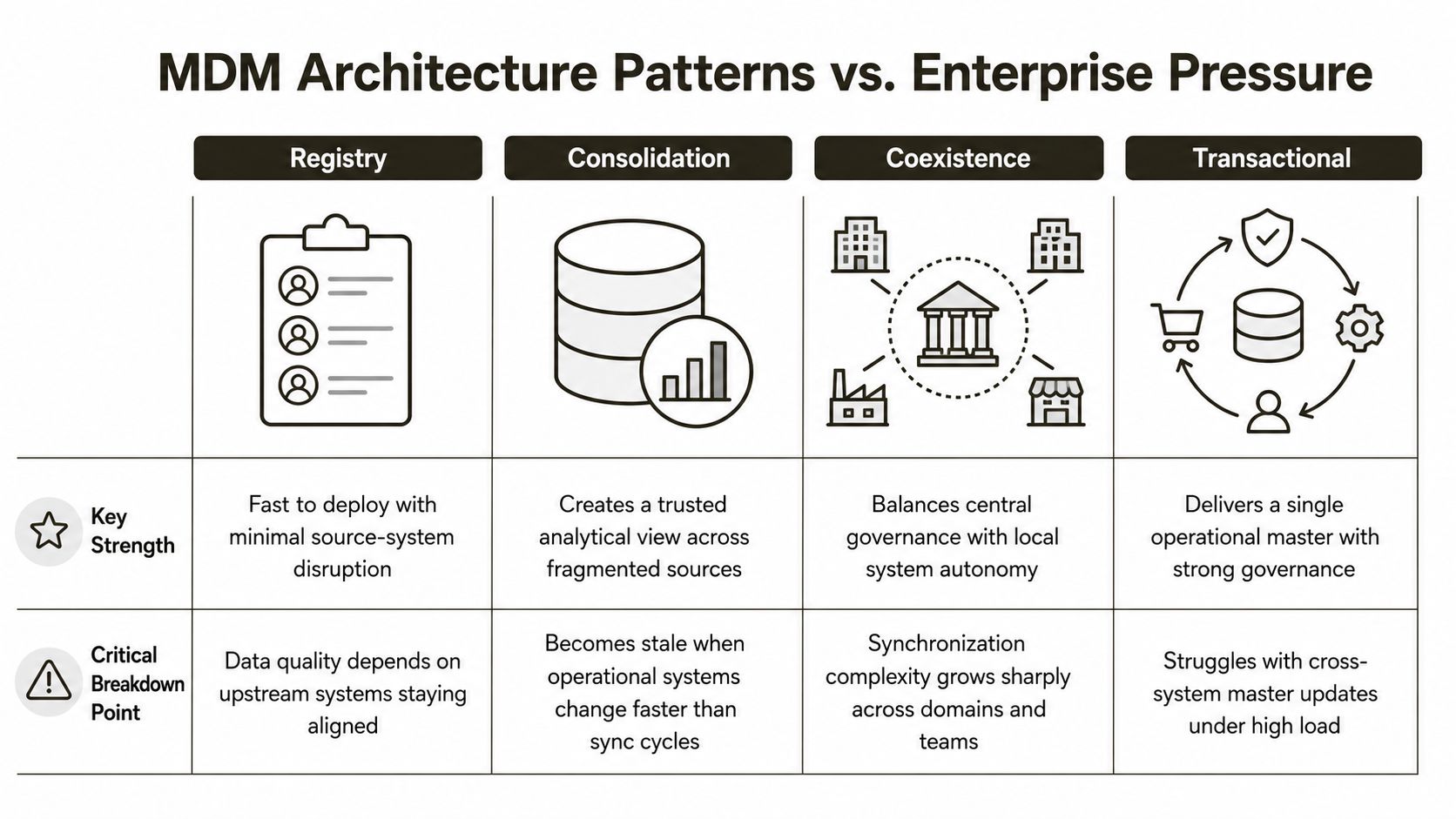
The architecture choice is not academic. It determines how badly your estate hurts when record volumes rise, hierarchies span domains, and business users keep changing upstream systems. At European scale, that matters because the region's managed record volume is already high enough that manual stewardship breaks down quickly, as noted in the market forecast cited earlier.
Registry and consolidation suit narrow control, not messy operations
A registry model keeps pointers to source systems rather than fully mastering everything. That can work when you need visibility more than operational write-back, but it breaks when the business expects the hub to correct source data. Consolidation goes further, building a central view for analysis and control, yet it still struggles when operational teams want immediate updates in every downstream app. These models reduce complexity, but they also leave gaps when exceptions need active governance.
That's why regulated estates often outgrow them. If finance, healthcare, or energy teams need deterministic approvals and traceable changes, a read-only or partially mastered model can become an expensive half-solution. It looks tidy in a diagram and awkward in production.
Coexistence and transactional create more power, and more failure modes
A coexistence model allows mastered data to flow both ways. That makes it attractive for enterprises that need shared ownership across systems, but it also introduces broken inheritance risk when hierarchies diverge. A transactional model goes further still, pushing master updates through operational processes. It gives you stronger control, but it also exposes you to API throttling, GUID conflicts, and synchronisation failures when records round-trip between ERP, CRM, and analytics.
If mastered data stops round-tripping cleanly, compliance and reporting drift apart long before anyone notices.
The right pattern depends on your estate, but the wrong pattern always creates remediation work. Once your hub can't keep hierarchies aligned, every downstream correction costs more than the original design decision.
Integration Failures That Undermine Data Trust
Most MDM projects don't die in the product demo. They die at the seam, where mastered data has to pass through ERP, CRM, reporting, and workflow tools that do not agree on timing, identifiers, or structure. That is the point where the “single source of truth” story gets stress-tested, and it usually breaks.
The hub isn't the problem, the round trip is
The documentation says integration is straightforward. In practice, consistent synchronisation across multiple systems depends on tight change governance, not just connector coverage. If a source system updates a customer hierarchy after the MDM hub has already mastered it, your golden record starts drifting. If the downstream app keeps an old GUID, you create conflicts that the business eventually mistakes for data corruption.
We often see clients fail when they assume the central hub can compensate for weak discipline elsewhere. It cannot. A missing update in one application can spread into reporting, billing, and service operations before anyone catches it. Teams running Microsoft-heavy estates should also look at Power Platform governance and the Dataverse vs SharePoint lists guide, because the wrong data store choice creates problems you end up fixing forever.
Broken seams create expensive silence
The worst integrations fail without a clean error. No exception fires, no red alert appears, and the record just becomes slightly wrong in multiple places. That silence is dangerous because business teams start working around the system instead of trusting it. Once that happens, stewardship becomes reactive and every correction takes longer.
The documentation says synchronisation is a feature. In reality, it is the thing that decides whether the programme survives contact with production.
That is why I don't trust any MDM pitch that handwaves integration. If the vendor cannot show you exactly how mastered records move back into source systems, and how it handles failures, your data trust will erode the first time a connector chokes or a hierarchy changes mid-stream.
Governance and Compliance Traps in Regulated Sectors
In finance, healthcare, and energy, MDM isn't a housekeeping tool. It's part of the compliance stack. If you can't prove which record was authoritative at a given time, or who approved the change, you're not just dealing with bad data, you're dealing with audit exposure.
Good records still fail audits when governance is weak
I've seen programmes that looked clean on paper fail because the stewardship trail couldn't prove decision history. The hub had data, but it couldn't explain why one source won over another, or who signed off on the exception. That matters when reporting chains depend on the same master data for regulatory submissions, operational controls, and internal assurance.
Dataversity is blunt about the business impact of poor master data, including delayed product launches, high supply chain costs, frequent customer complaints, and hefty regulatory penalties (Dataversity). That's the right lens. A weak governance model doesn't just slow work. It can break legal compliance.
Manual stewardship does not scale under pressure
Gartner benchmarks cited in industry reporting show organisations can see up to a 20% improvement in data accuracy and a 15% gain in organisational efficiency with MDM, but those gains disappear fast if you rely on ad hoc approvals and manual merges (Semarchy). The same source notes poor data quality costs USD 12.9 million per year on average, which is exactly why DIY governance collapses when compliance review starts asking hard questions.
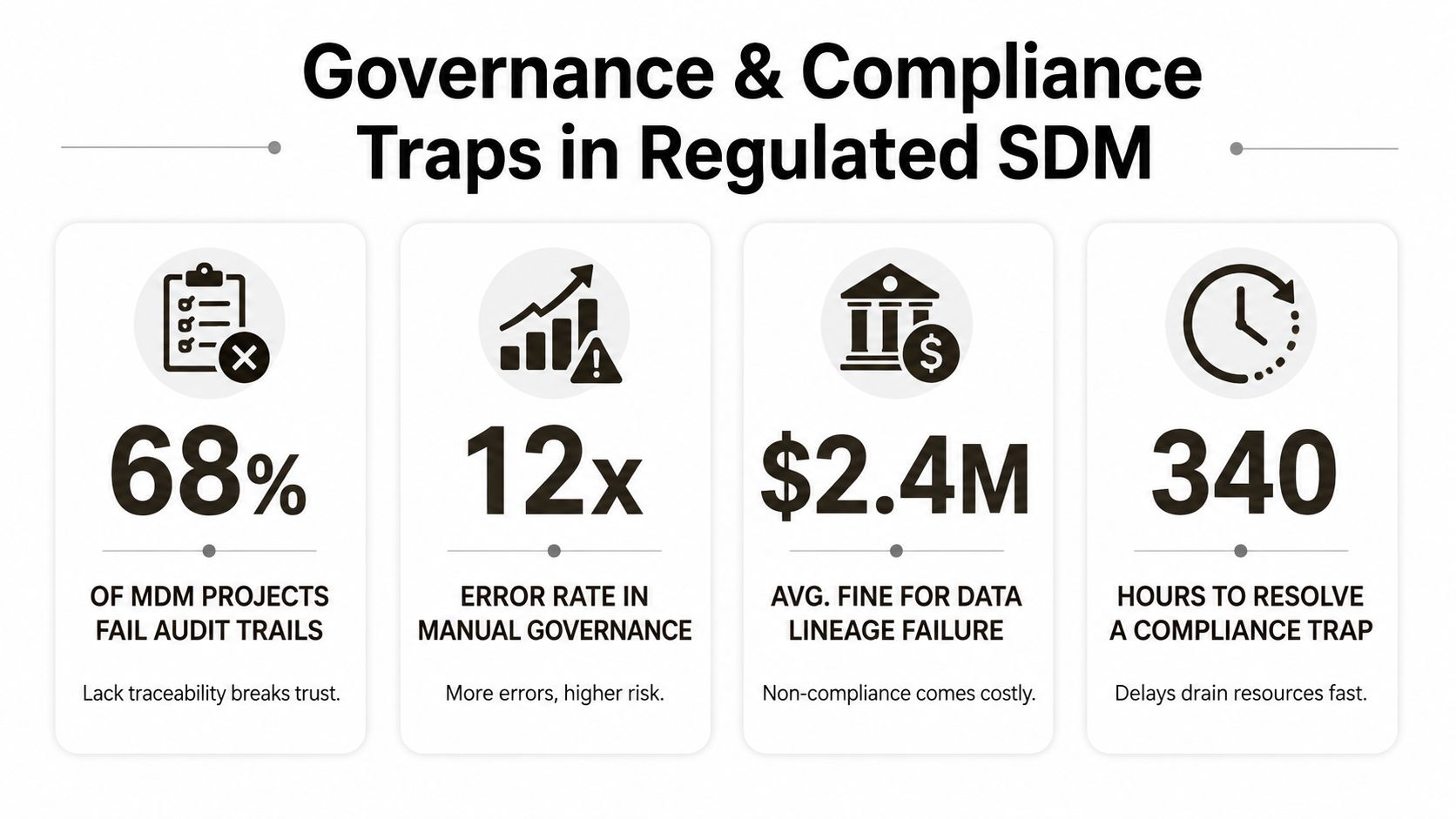
The lesson is ugly but simple. If your approval rules aren't deterministic, your audit trail won't save you. If stewardship sits in one person's inbox, your MDM programme is one resignation away from collapse.
Your Enterprise MDM Evaluation Checklist
Test the vendor against your dirty data
Start with your worst sample, not the vendor's demo data. Feed in duplicate customers, inconsistent product hierarchies, stale supplier records, and bad identifiers. Then watch what the matching engine does when the records disagree. If the vendor only shines on pristine data, it will fail in your estate.
Force the hard questions on lineage and survivorship
Ask for one regulated report and trace it back to source. Then check whether the platform shows the full change history, the approval chain, and the survivorship rule that chose each attribute. You're not testing pretty screens. You're testing whether the system can defend itself under audit.
Demand evidence of exception handling
Stewardship workflows have to survive volume, not just a sandbox. Verify that exception queues stay manageable when multiple domains collide, and ask what happens when the same entity appears with different GUIDs across connected applications. If the answer sounds hand-wavy, the platform won't survive production pressure.
Validate failover, round-tripping, and reference fit
A real evaluation also needs a reference in your industry, not just a logo slide. Run failover in a sandbox, then test what happens when mastered data stops round-tripping cleanly to ERP or CRM. The right platform will surface the break, not hide it.
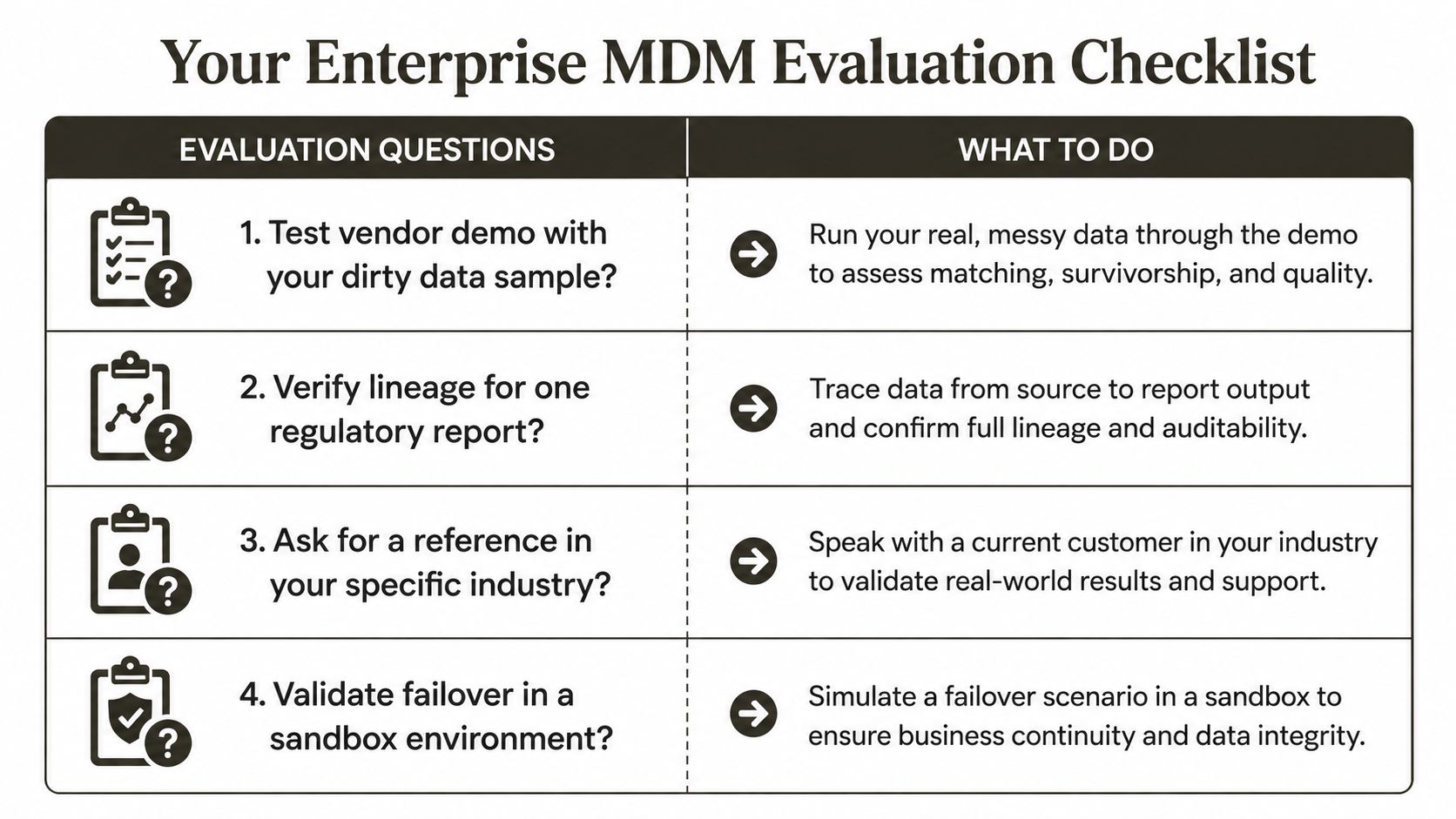
If a vendor can't prove these basics with your data, move on. You're not buying an MDM brochure, you're buying a control system.
AI Readiness and the Data Portability Problem
AI has made lazy MDM worse. The golden record no longer feeds just operations, it feeds models, analytics, governance layers, and automation. If your master data isn't structured, traceable, and portable, AI will happily learn from the wrong thing.
Clean data is not the same as useful data
A lot of teams celebrate consolidation too early. They centralise records, then assume the AI layer will figure the rest out. It won't. The model only trusts the input it gets, and if your lineage, stewardship, and attribute rules are weak, your AI stack inherits the same uncertainty in a shinier format. That's why MDM now has to support downstream trust, not just record storage.
The gap is especially visible in Microsoft-heavy estates, where teams try to bolt modern AI on top of governance they never finished. The Azure OpenAI vs Microsoft Copilot comparison is useful here because it shows how quickly the governance layer becomes the main constraint, not the model choice.
Portability beats platform lock-in
If master records can't move cleanly across systems, they can't support analytics at pace. That creates a bottleneck when teams want to reuse the same golden record for reporting, operational workflows, and AI training. We often see clients fail when they treat downstream AI as a separate project. It isn't. It depends on the same mastering discipline.
The point is simple. AI-readiness doesn't come from adding a model on top of messy master data. It comes from building MDM so the golden record stays explainable, transferable, and trusted across every consumer.
The Risk Case for Specialist Engagement Over DIY
DIY MDM is attractive because it looks controllable. In practice, it usually becomes fragmented, under-governed, and expensive to fix. The cost isn't the first deployment. It's the remediation when compliance review, integration drift, and stewardship fatigue hit at the same time.
The hidden bill shows up after go-live
A failed MDM rollout doesn't just waste software spend. It creates rework in every connected system, slows reporting, and erodes trust in the data that leaders use for decisions. Gartner benchmarks cited in industry reporting point to up to a 20% improvement in data accuracy and a 15% gain in organisational efficiency when MDM is done properly, while poor data quality costs USD 12.9 million per year on average (Semarchy). If you miss the governance piece, you don't get those gains. You get a longer queue of fixes.
Specialists reduce the probability of a second failure
A specialist team doesn't just install software. It designs the stewardship model, the exception handling, the integration seams, and the rollout order so the programme can survive production pressure. That's the difference between a patchwork fix and a governed implementation. If you want a parallel from Microsoft 365 work, the admin vs consultant comparison makes the same point, DIY ownership sounds cheaper until the recovery work starts.
The Ollo verdict is straightforward. Use DIY only for trivial, low-risk data cleanups. For complex MDM in regulated, multi-system estates, you need a specialist team that knows where the bodies are buried and how to keep them from coming back.
If your master data is already crossing ERP, CRM, analytics, and compliance boundaries, don't guess your way through the next implementation. Talk to Ollo about a governed MDM approach that treats integration, stewardship, and auditability as the core design, not afterthoughts. We help teams avoid the usual failure modes, then build a rollout plan that can survive real production pressure.