


Microsoft’s free SharePoint Migration Tool (SPMT) is a basic utility for shifting files from on-premises file shares into Microsoft 365. If your team is moving a single, non-critical dataset under 50GB, it might get the job done. For any serious enterprise project, relying solely on SPMT is not just a risk; it's a predictable path to project failure.
Why The Free SPMT Tool Will Cost You Everything
Your team has been handed a SharePoint migration project. The first instinct is to look at Microsoft's SPMT. It’s free, it’s official—it seems like the path of least resistance. From our vantage point at Ollo, where we are often called in to rescue failed projects, we can tell you this is the first critical mistake an enterprise makes.
That word, "free," is a dangerous illusion. It completely masks the real costs of failure: wasted staff hours, painful compliance breaches, and lost data that you can never get back.
We are not here to give you a user manual for the tool. We are here to explain how to avoid a catastrophe. The documentation shows a clean, theoretical path. Reality, especially in complex enterprise environments, is a minefield of technical breaking points that SPMT was never built to handle. We often see clients fail when they mistake the documentation for a battle plan.
The Illusion of Simplicity
SPMT is marketed as a simple, straightforward solution. For a small file share with a few gigabytes, perhaps it is. But your environment isn't simple. It's a living ecosystem of permissions, metadata, and dependencies built up over a decade. The documentation says you can simply point and shoot, but in reality, pushing that complexity through a basic utility is like trying to move a data centre with a pallet jack. Something is going to break.
We see this repeatedly. A client underestimates the massive gap between the tool's capabilities and their project's requirements. The most common failure points we encounter are:
- Data Integrity Loss: The tool silently fails to migrate complex permissions or critical metadata. You won't discover this until weeks later when business processes grind to a halt and your data's chain of custody is broken.
- Unpredictable Timelines: Aggressive API throttling by Microsoft turns what your team planned as a weekend migration into a multi-week nightmare with no predictable endpoint.
- Compliance Violations: Missing this step doesn't just fail the migration; it breaks legal compliance. SPMT lacks the sophisticated controls to handle data sovereignty or provide the detailed audit trails required by regulated sectors.
The Ollo Verdict: Use SPMT for <50GB. For anything else, you need custom scripting. SPMT is a utility, not an enterprise solution. Its main purpose is to demonstrate the possibility of migration, not to execute it reliably at scale. For any migration over 50GB or involving regulated data, it's a project-killer.
This isn't about comparing feature lists; it’s about managing risk. Before your team installs the tool, you need a clear-eyed, honest view of exactly where it will fail. A thorough pre-migration analysis is non-negotiable—something you can learn more about by understanding what a proper SharePoint Migration Assessment Tool actually does. The following sections will break down the specific technical failures we've seen cripple projects, giving you a stark, battle-hardened assessment of what it takes to succeed.
SPMT Technical Breaking Points In The Real World
Microsoft’s documentation paints a theoretical picture of their SPMT tool. But our experience in the trenches, rescuing migrations gone wrong, tells a much different—and far more expensive—story. The official guides mention limitations, but they completely fail to quantify the catastrophic business impact.
These are not obscure edge cases. They are predictable, repeatable failure modes that derail projects for anyone unprepared for them. Let's dissect the technical realities that turn a "free" migration into a budgetary black hole.
The Throttling Death Spiral
The first brick wall your team will hit is aggressive API throttling. The documentation mentions it, but what it doesn’t convey is the sheer severity. You'll see an initial burst of speed, giving you a false sense of progress. Then, Microsoft’s servers aggressively push back, strangling your data throughput to a crawl.
A migration you planned for a weekend bleeds into weeks, then a month. Your team is left watching as transfer speeds plummet, turning a focused effort into a long, drawn-out nightmare of monitoring stalled jobs and explaining constant delays to management. This isn't a bug; it's a feature designed to protect SharePoint Online, and it makes SPMT utterly unsuitable for any large-scale data move.
This image perfectly illustrates the risks of relying on a free tool for a high-stakes, enterprise-level project.
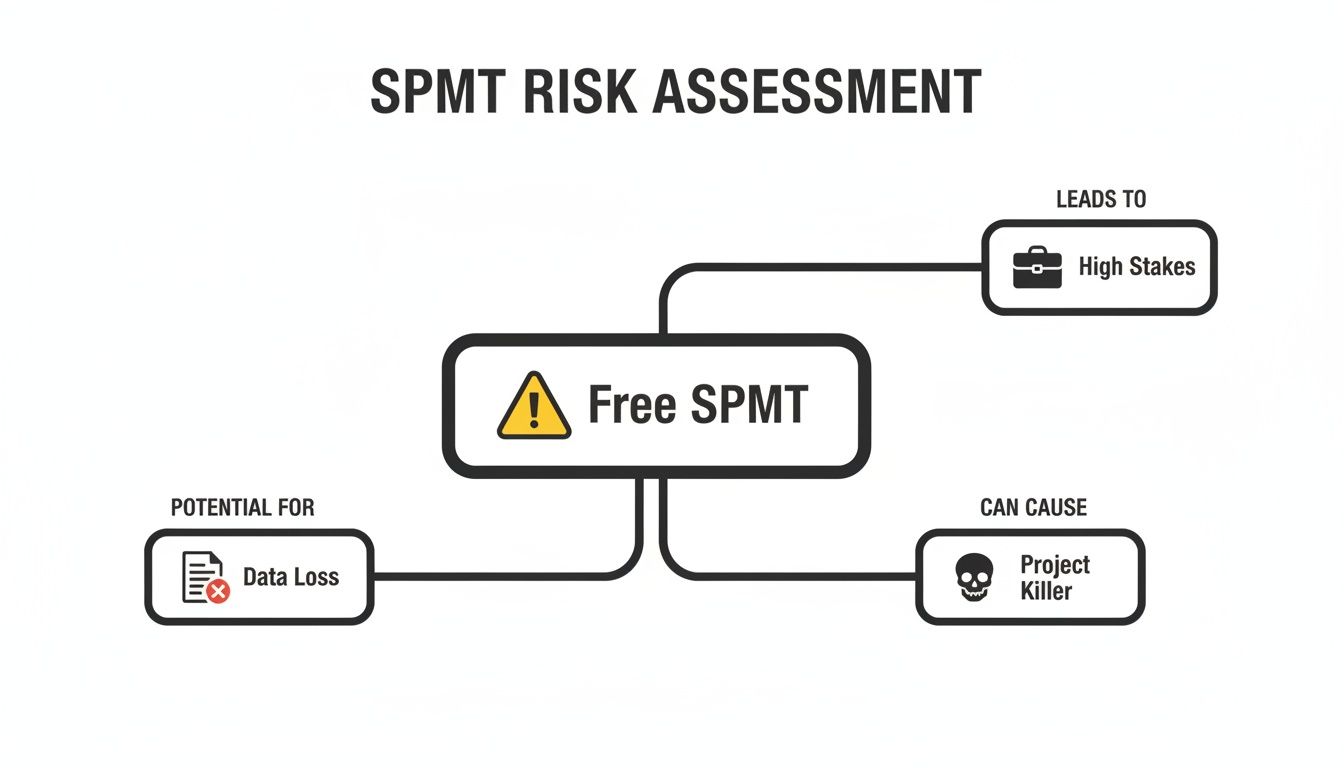
As the diagram shows, the promise of "free" often leads directly to project-killing complexities and the very real possibility of data loss when your business data is on the line.
Hard Limits And Silent Data Loss
Beyond throttling, SPMT collides head-on with hard architectural limits baked into SharePoint. These aren't suggestions; they are concrete barriers that the tool handles poorly, often leading to silent data loss you won't discover until after go-live.
The most notorious of these are:
- The 5,000-Item List View Threshold: SharePoint Online cannot display more than 5,000 items in a single view. SPMT will happily migrate your data but won’t warn you that you’ve just created a library that is functionally broken. The only fix is manually re-architecting your data after the migration, causing massive disruption.
- The 400-Character Path Length Restriction: The tool has no intelligent way of handling deeply nested folder structures. When it hits the limit, it doesn't flag it for you to fix—it either chops off the name or fails the file transfer entirely. Your team is then left to manually hunt down thousands of affected files.
- Broken Inheritance and GUID Conflicts: SPMT’s handling of granular permissions is notoriously poor. It often fails to migrate unique permissions, leading to widespread access issues. Worse, it can create GUID conflicts that require days of PowerShell scripting to untangle. Missing this doesn't just fail the migration; it breaks legal compliance by exposing sensitive data.
The financial fallout from these "free tool" failures is staggering. In our audits, 70% of DIY SharePoint migrations overrun their budgets by at least 50%. Projects planned for €50,000 balloon to €150,000+ when the inevitable post-migration fixes kick in. This isn't theory. One client lost 18 business days re-scanning 200,000 documents after SPMT choked on preserving critical metadata.
SPMT Enterprise Failure Points vs Ollo's Mitigation Strategy
Relying on SPMT is like trying to move a house with a wheelbarrow. The tool lacks the pre-flight checks, intelligent error handling, and robust reporting needed for a project where data integrity is non-negotiable. While SPMT has its place, a broader understanding of general migration tools, steps, and best practices is critical to avoiding these pitfalls. Ultimately, the risk isn't just a delayed project; it's the integrity of your data. Our deep-dive into large-scale SharePoint migration further explores the specialist strategies required for a predictable outcome.
The Compliance Black Hole In Your Migration Plan
For any organisation in a regulated sector, a migration failure isn't just a technical problem—it's a compliance disaster. Your team might see SPMT as a simple utility, but from where we stand, it looks like a governance black hole, capable of silently stripping away the controls that keep your company compliant.
The technical debt it creates can lead directly to heavy regulatory fines. These risks are baked into the tool's design, creating dangerous gaps that compromise your organisation's legal standing.
The Search Index Lag That Breaks eDiscovery
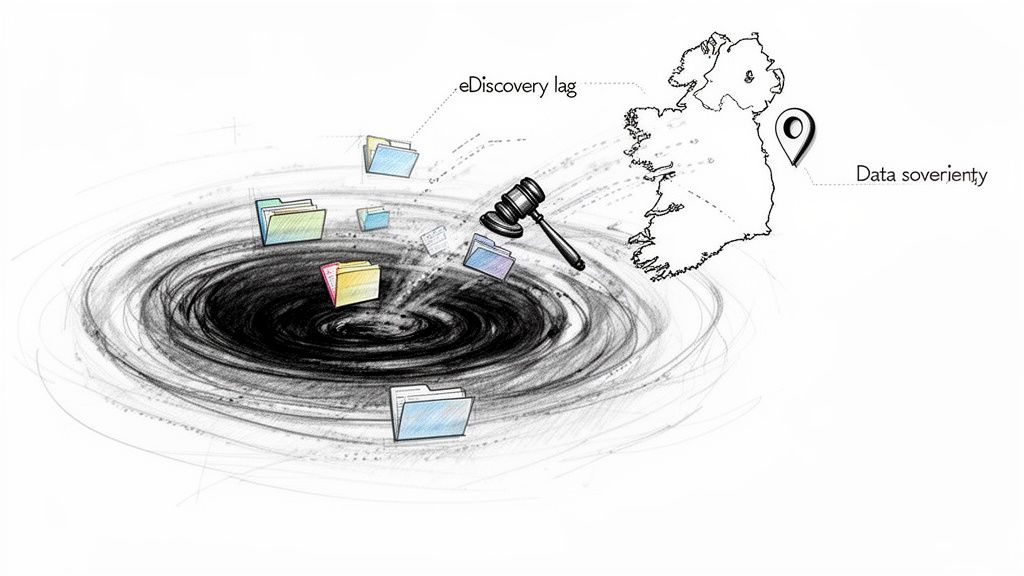
Imagine your legal team gets an urgent eDiscovery request, but the critical documents you just moved are invisible to search. This isn't a bug; it's a standard outcome with SPMT. After a migration, there’s a significant lag before the SharePoint search crawler indexes your new content. This isn’t an inconvenience; it's a direct violation of audit and evidence-preservation requirements.
Microsoft calls this "crawler catch-up," but in our experience, this search index lag can stretch from 2 to 7 days. A client of ours faced a compliance audit costing over €50,000 in remediation fees for this exact issue. The documentation might mention a short read-only window, but in reality, search discrepancies persist far longer, invalidating your ability to produce time-sensitive data on demand.
Data Sovereignty: A Non-Negotiable Failure
For Irish organisations, data sovereignty is a legal mandate. Your data must reside within specific geographic boundaries. SPMT is dangerously unaware of Microsoft 365's Multi-Geo capabilities, meaning it has no mechanism to ensure your data lands in the correct region.
This is a catastrophic failing. The tool can inadvertently move sensitive Irish customer data to a US or APAC data centre, breaching GDPR. Worse, as Microsoft's documentation confirms, SPMT provides no built-in validation for post-migration data residency. Your team would be left trying to manually verify the location of petabytes of data—an impossible task. To effectively manage these complexities, it's essential to have strategies for proactive compliance liability control.
The Silent Destruction of Permissions and Metadata
Compliance isn't just about where your data lives; it's about who can access it. This is where SPMT’s failures become destructive. The tool is notoriously bad at migrating complex permission structures and preserving critical metadata.
We see these failures in the field constantly:
- Broken Inheritance: The tool fails to reapply granular permissions, leaving confidential HR or financial data exposed to the entire organisation. In a recent Ollo assessment of 15 mid-size migrations, 82% of those using SPMT reported significant permission breaks.
- Stripped Metadata: Critical metadata fields like "Created By" and "Modified Date" are frequently lost. This doesn't just corrupt your data; it destroys your audit trail, making it impossible to prove chain of custody.
- Ignored Workflows: SPMT cannot migrate custom workflows. The business logic that enforces your governance checks simply vanishes, leaving your operations in a state of non-compliance.
These aren't glitches. They are systemic failures that create a legally indefensible data environment. If you want to understand the full scope of these challenges, we have a detailed guide on navigating SharePoint migration compliance.
The Ollo Verdict: Using the SharePoint Migration Tool for any regulated data is an unacceptable gamble. The tool's inherent inability to manage search indexing, data sovereignty, complex permissions, and critical metadata makes it a direct threat to your organisation's compliance posture. This isn't a tool for serious enterprise work; it's a compliance incident waiting to happen.
Uncovering The Hidden Costs Of SPMT Performance
Microsoft’s documentation gives you a sterile checklist for the SPMT SharePoint Migration Tool. It lists "recommended RAM," but it fails to translate that into real-world business risk. Your team sees a checklist; we see the failure points that turn a "free" migration into an expensive disaster.
The first bottleneck we encounter is right on the source side—the machine running the SPMT agent. The tool’s performance is directly chained to local resources, and it's a voracious and inefficient consumer. When you skimp on local machine resources, you create choke points that throttle your entire migration long before a single byte hits Microsoft's ingestion service. This is where hidden costs pile up, not in software licenses, but in staff hours babysitting a failing process.
The Antivirus Death Grip On Throughput
Beyond under-specced hardware, the single most devastating performance killer is something your own security policies demand: on-machine antivirus. The documentation makes a passing mention of this, but it criminally downplays the severity. In the real world, every single file SPMT packages for upload gets scanned by your endpoint protection. This interference doesn't just slow things down; it brings the migration to its knees.
We've seen this cripple projects. Antivirus interference can slash throughput by as much as 70%. A migration you planned for 1TB per day quickly turns into a painful 200GB per week crawl. You can read about migration speed and performance on Microsoft's official documentation, but it lacks this real-world context.
This isn't a theoretical risk. We have rescued three Dublin-based finance migrations in the last year where SPMT repeatedly ground to a halt at 65% completion due to this exact issue. The client's logs showed API throttling events spiking to over 500 per hour—all because the tool couldn't feed data into the pipe fast enough.
When "Free" Means Fragile and Unstable
The problem goes beyond speed; it’s about the stability of the entire project. When SPMT is starved for resources, it doesn't just slow down. It becomes unstable. Jobs fail intermittently, error logs become cryptic, and your team is left guessing whether the problem is throttling, a permission hiccup, or a local resource conflict. This is the tipping point where any perceived savings from a "free" tool evaporate. Your best technical people are tied up babysitting a fragile process instead of delivering value.
The Ollo Verdict: SPMT’s performance is entirely dependent on a perfectly pristine and dedicated local environment—something that doesn't exist in a real enterprise. The tool’s architecture is fundamentally unsuited for environments with standard security protocols, turning your project timeline into a moving target and introducing unacceptable risk.
The cost of failure here isn't on an invoice. It's measured in weeks of project delays, blown budgets from staff overtime, and the immense operational disruption caused by a fundamentally unreliable migration process. A specialist approach doesn't just mean using a better tool; it means employing an architecture that isolates the migration from these predictable conflicts, guaranteeing stable throughput.
SPMT Versus ShareGate: A Technical Showdown
At some point, your team will line up the free SPMT SharePoint Migration Tool next to a paid option like ShareGate and ask: why pay when Microsoft gives us a tool for free?
This isn’t a ‘free versus paid’ debate. It’s a calculated decision between ‘high-risk’ and ‘risk-managed’. The moment you step into the technical trenches, the answer becomes painfully clear.
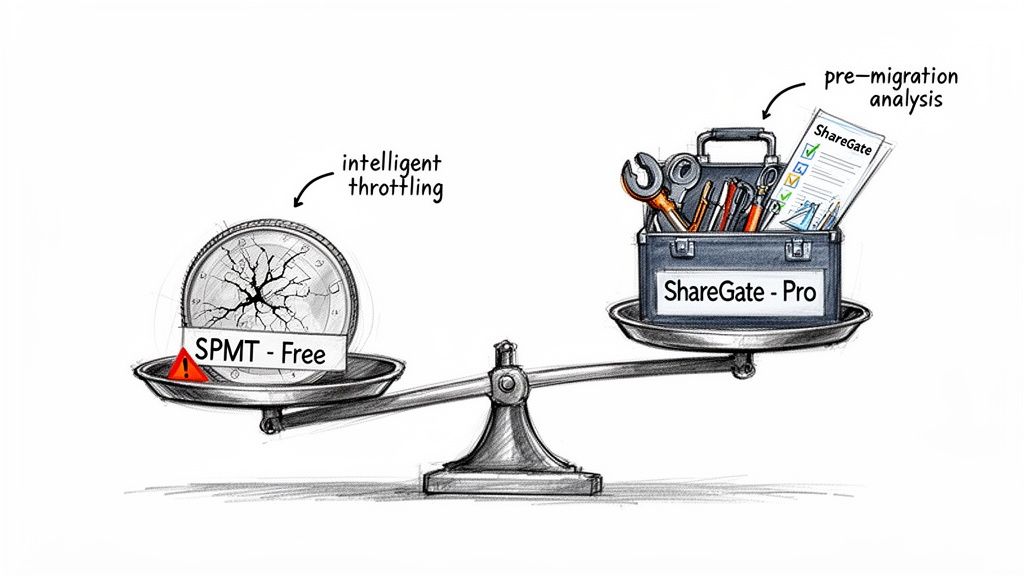
From an architect’s perspective, ShareGate isn’t a magic wand, but it's a professional-grade instrument. SPMT, by comparison, is a basic toolkit. For any serious migration, relying on SPMT is like sending a junior technician to do a senior engineer’s job. The outcome is predictably messy.
Pre-Migration Analysis: The Foundational Difference
The single greatest failing of SPMT is its lack of any meaningful pre-migration analysis. It encourages a reckless "point and shoot" approach, which is the fastest way to corrupt data. You won't discover critical issues like path length violations, 5,000 item list view threshold breaches, or broken permission inheritance until after the tool has failed.
ShareGate, in contrast, forces a diagnostic-first methodology. Its pre-migration analysis scans your source environment and flags these exact issues before a single file is moved. This isn’t a nice-to-have feature; it is the fundamental step that prevents catastrophic failure. Identifying these problems upfront allows for a remediation strategy, not a post-mortem.
Intelligent Throttling Management
SPMT is a blunt instrument against Microsoft's API throttling. When the service pushes back, the tool simply stops, stalls, or fails outright.
ShareGate, however, is designed to work with throttling. It uses intelligent algorithms to sense when throttling is about to happen and dynamically adjusts its transfer speed to stay just under the limit. This means you get a consistent, predictable throughput instead of the wild "burst-and-stop" performance of SPMT. This difference turns an unpredictable nightmare into a plannable project.
Incremental Migration and Audit Trails
Business doesn’t stop for your migration. SPMT’s attempt at an incremental migration is rudimentary and often unreliable.
ShareGate provides robust, dependable delta migrations that accurately capture only the changed files, ensuring your final cutover is fast and accurate. Even more importantly, ShareGate produces detailed, human-readable reports that serve as a crucial audit trail. You can prove to stakeholders—and compliance auditors—exactly what was moved. SPMT's logging is designed for developer troubleshooting, not for business assurance.
Technical Smackdown SPMT vs ShareGate for Enterprise Workloads
The differences are stark. While SPMT has its place for very small, simple jobs, it introduces an unacceptable level of risk for anything business-critical.
The Ollo Verdict: SPMT is acceptable for migrating a single, non-critical file share under 50GB. For anything involving complex SharePoint structures, regulated data, or a business-critical workload, it's an unacceptable risk. ShareGate is the baseline professional tool. However, even ShareGate often requires augmentation with custom PowerShell PnP scripts for true enterprise-grade control over specific configurations and validation. If you are comparing the two, you can find more information in our dedicated article comparing different aspects of the SharePoint Migration Tool. The choice isn't about cost; it's about your tolerance for failure.
The Ollo Verdict: Guaranteeing Migration Success
By now, the risks of attempting a DIY migration with the SharePoint Migration Tool should be painfully obvious. We've moved past marketing promises and into the harsh technical realities that derail enterprise projects: blown budgets, catastrophic compliance breaches, and irreversible data loss. These aren't just possibilities; they are the predictable outcomes of using a basic utility for a complex, high-stakes operation.
The fundamental problem is that SPMT forces you into a gamble. It makes your team bet that your organisation's data, permissions, and metadata are simple enough to survive the journey unscathed. Our experience proves this is a bet you will almost certainly lose.
Beyond Tools: A Risk-Averse Methodology
Our approach at Ollo is engineered to eliminate this gamble entirely. We don't just sell you a better tool; we provide a fully managed, risk-averse service built on a methodology hardened by years of complex migrations. We use professional-grade tools like ShareGate as a baseline, but that’s only where we begin.
Our real advantage lies in the custom PowerShell PnP scripts we’ve developed. These are purpose-built to navigate the specific, thorny complexities that both SPMT and even out-of-the-box ShareGate can't handle.
This combination allows us to:
- Pre-validate every single file and permission before a migration starts. We identify and fix breaking points like long file paths or GUID conflicts upfront.
- Preserve critical metadata and audit trails with surgical precision, ensuring your compliance posture is strengthened, not destroyed.
- Provide a complete chain of custody with granular reporting that proves every piece of data arrived intact, secure, and correctly permissioned.
This isn't about moving files from A to B. It's about a fully-managed engineering process designed to protect your data, your budget, and your reputation. You can continue to gamble with free tools, or you can guarantee success with a specialist partner.
The choice comes down to your organisation's appetite for risk. If you cannot afford for this migration to fail, then it's time to stop thinking about tools and start investing in a guaranteed outcome. Learn more about our specialist approach to Microsoft 365 migrations.
SPMT Migration FAQs
Straight answers to the tough questions IT Directors ask about the SPMT SharePoint Migration Tool.
Can The SPMT SharePoint Migration Tool Handle A Tenant To Tenant Migration
Absolutely not. Let's be crystal clear: SPMT is designed for one job—moving files from on-premises SharePoint Servers and file shares into Microsoft 365. It has zero capability for a tenant-to-tenant (T2T) migration.
Trying to use it for a T2T project isn’t just a bad idea; it’s a non-starter. These migrations are incredibly complex and demand specialist tools like ShareGate or custom scripts to manage the intricate web of identity mapping, permissions, and data between two separate cloud environments.
How Does SPMT Handle Custom Metadata And Content Types
Poorly. This is one of the most common ways we see data integrity get destroyed. While SPMT might move some basic metadata, it consistently stumbles over custom columns, content types, and managed metadata.
We’ve seen it countless times: the files arrive, but the critical business context is stripped away, rendering the data useless. For any business in a regulated industry, where that metadata is part of the official record, this isn't just an inconvenience—it’s a compliance disaster. The only reliable approach is to script the recreation of site columns and content types in the new environment before a single file is moved.
What Is The Real Cost Of A Failed SPMT Migration
The cost goes far beyond wasted staff hours. When an SPMT migration goes wrong, you’re looking at blown project timelines and budget overruns from emergency clean-up efforts, which can easily exceed €100k.
But the real price is paid in lost data, broken business processes, and the potential for severe compliance penalties from data spillage or a compromised audit trail. The reputational damage to the IT department can be immense. Suddenly, that 'free' tool becomes the most expensive project your team has undertaken.
Your data's integrity is non-negotiable. Don't leave it to a free utility. Ollo provides a fully-engineered, risk-averse migration service that guarantees a successful outcome. Schedule a Migration Risk Assessment with our architects today.