


The popular advice about internet of things solutions is wrong. It tells you to focus on sensors, dashboards, and automation wins. That's the glossy part. The part that destroys projects sits underneath: identity, ingestion, retention, permissions, and the ugly collision between machine telemetry and Microsoft 365 governance.
Your team isn't just connecting devices. You're connecting operational risk to a collaboration platform that was never designed to absorb raw, high-frequency telemetry without careful engineering. The documentation says the platform supports migration and ingestion patterns. In reality, enterprise workloads expose every weak point at once.
Beyond the Hype The Real Risks of Enterprise IoT Integration
Most IoT programmes fail in the backend, not at the device edge. The device connects. The proof of concept works. Then the full scope of the problem appears: retention rules, audit requirements, permission inheritance, throttling, malformed metadata, and a flood of telemetry nobody modelled properly.
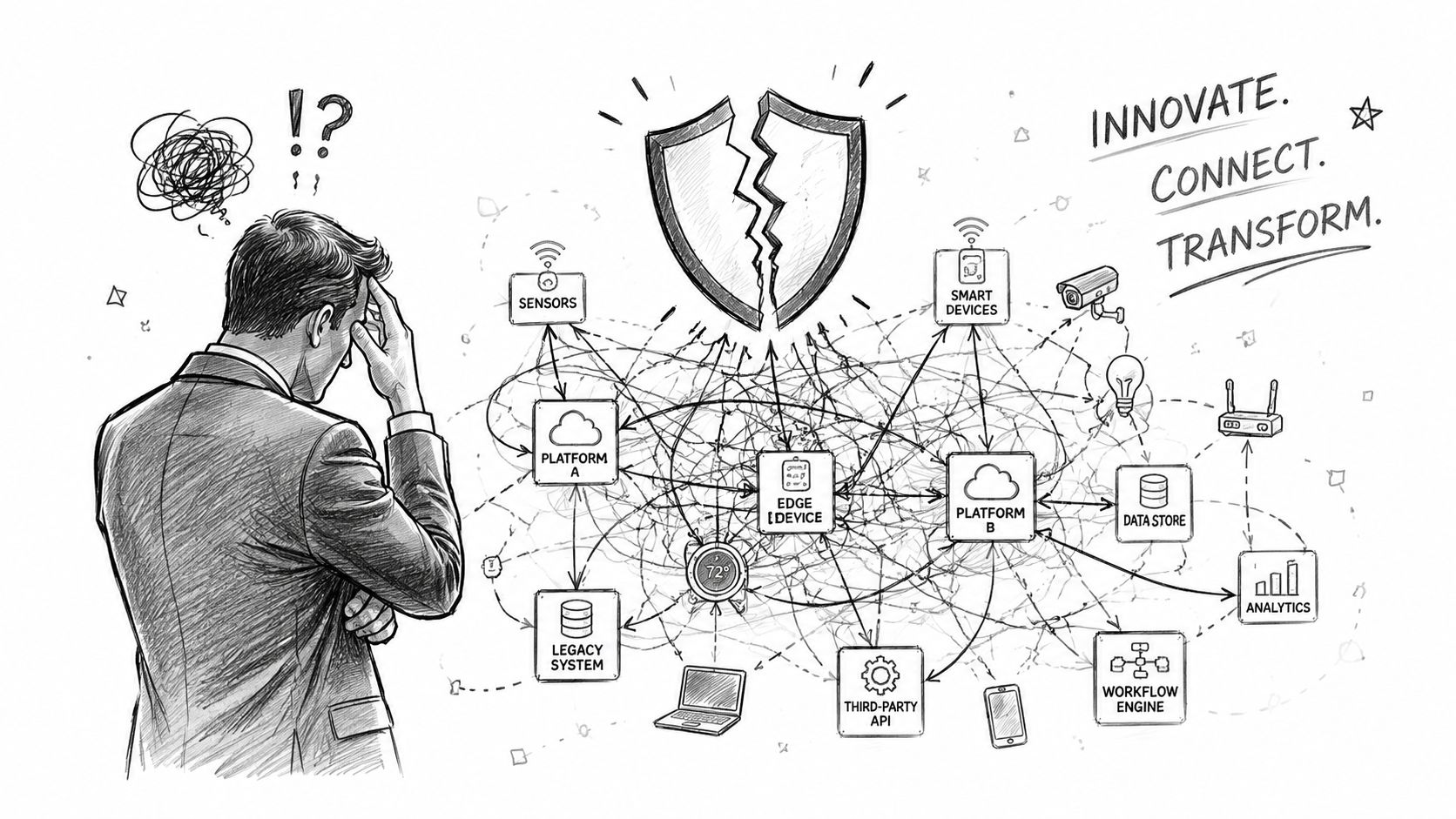
The scale alone should end any casual DIY thinking. The global IoT end-user solutions market is projected to reach $1.6 trillion by 2025 according to Digital Matter's global IoT adoption overview. That matters because scale creates operational pressure. In regulated environments, that pressure shows up as unmanaged API throttling and broken inheritance when teams start moving large telemetry datasets into Microsoft 365.
What buyers get wrong
The common assumption is simple: if the device estate works, the data estate will follow. It won't.
We often see clients fail when they treat IoT as an isolated operational technology project instead of a cross-domain integration problem. The first warning sign usually isn't a failed sensor. It's governance drift. A team stands up ingestion pipelines quickly, then discovers that legal hold, access control, searchability, and downstream reporting all depend on structures they never designed.
A lot of teams researching device platforms also overlook the software layer that sits around the estate. If you're evaluating options, a practical reference point is software for Zoho IoT, not because one catalogue solves enterprise architecture, but because it reminds you that platform choice affects integration discipline later.
The expensive part of IoT isn't the pilot. It's the moment your pilot has to behave like regulated infrastructure.
The hidden breakpoints
The brochure talks about visibility. The rescue work talks about failure modes.
- API throttling hits first: High-volume polling and bulk updates don't respect your project plan. Microsoft 365 enforces limits whether your migration window likes it or not.
- Permissions become toxic: Broken inheritance spreads unnoticed. One bad design choice at a library or site level can corrupt your access model across telemetry-driven content.
- Data lands in the wrong place: Teams often dump operational data into SharePoint structures that can't tolerate the query pattern.
- Compliance gets dragged in late: Missing governance controls doesn't just create disorder. It can break legal and regulatory obligations.
If your environment includes mobile assets or distributed operations, that integration risk becomes even more obvious in scenarios like vehicle tracking and fleet management, where telemetry value depends on disciplined identity and data handling, not just device uptime.
Architectural Patterns That Survive Contact with Reality
Reference diagrams look clean because they omit the stress. Real internet of things solutions don't fail because architects forgot boxes and arrows. They fail because those boxes and arrows collapse under latency, polling frequency, and governance demands from regulated enterprises.
A survivable architecture starts with one rule. Don't let raw operational urgency dictate your cloud pattern.
The baseline pattern that usually breaks
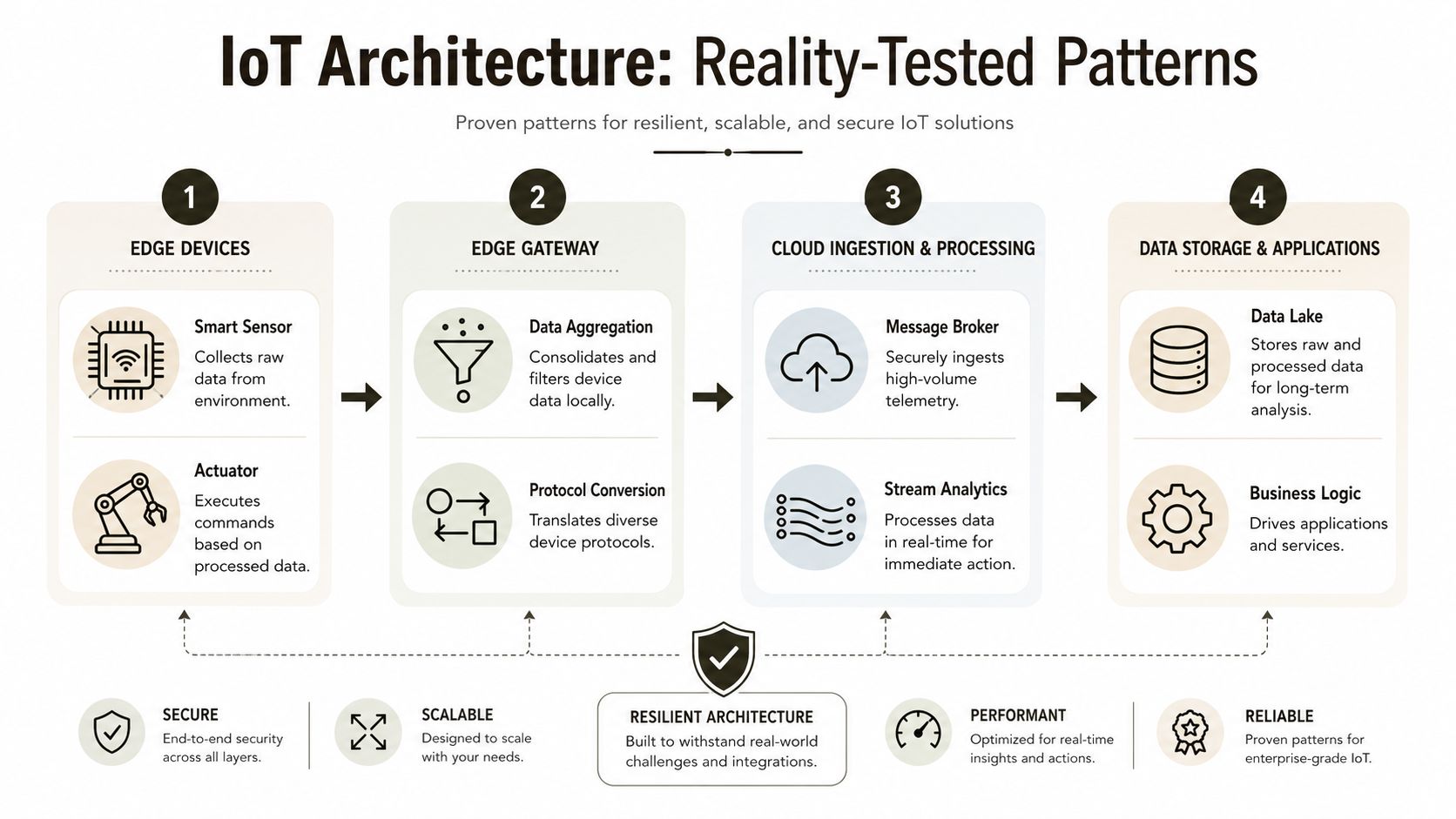
Typically, teams assemble some version of this flow:
- Edge devices collect events
- A gateway aggregates and converts protocols
- A cloud broker ingests telemetry
- Analytics or workflow tools push data into business systems
- Microsoft 365 becomes the reporting, document, or case-management surface
That pattern isn't wrong. It's incomplete. In Energy and Finance, IIoT solutions in the IE region must integrate architectures that address the 1ms latency requirement for critical automation, as outlined in Ericsson's IoT analysis. Miss that requirement and you invite API throttling and data loss during high-frequency sensor polling.
The documentation says generic cloud-first patterns can stretch to industrial use cases. Reality is harsher. If critical actions depend on near-real-time response, then pushing everything northbound to cloud services before control logic settles is architectural negligence.
What resilient design actually requires
A battle-tested pattern separates functions aggressively.
- Edge first for critical logic: Keep time-sensitive filtering, buffering, and local decision paths close to the device estate.
- Gateway discipline matters: Protocol conversion isn't a convenience feature. It's where weak schemas, timestamp drift, and malformed payloads start poisoning your downstream systems.
- Cloud ingestion must be throttling-aware: Message brokers and stream processors need retry logic, back-pressure handling, and route isolation.
- Microsoft 365 should receive curated data, not firehose telemetry: If you dump raw event volume into collaboration services, your design is already failing.
For teams working on predictive maintenance patterns, Forge Reliability on predictive maintenance is useful background because it reinforces a practical truth: the value comes from signal quality and operational modelling, not from indiscriminate data hoarding.
This visual captures the architecture hierarchy well before compromises begin.
The pattern I trust in regulated estates
I trust architectures that assume failure and contain it.
Practical rule: If your design can't lose a gateway, buffer telemetry, preserve identity context, and still land governed business data correctly, it isn't ready for production.
That means your Azure layer needs clear boundaries between ingestion, transformation, and business exposure. It also means your Microsoft estate needs deliberate integration paths, not enthusiastic connector sprawl. If you're building that foundation in Microsoft's stack, Azure integration architecture is where the operational and governance layers have to meet cleanly.
The Ollo Verdict
Use a simple cloud pattern for low-risk, non-critical telemetry. The moment your use case involves regulated data, high-frequency polling, or operational consequence, you need an architecture built around buffering, isolation, identity, and custom control points. Anything less is a pilot wearing enterprise clothes.
Securing the Chain from Device to Data Lake
Most IoT security advice is shallow. It stops at device hardening, transport encryption, and maybe gateway segmentation. That isn't enough. Your real attack surface runs from device identity to protocol handling to ingestion rules to the permissions model in the system where data finally lands.
If any link in that chain is weak, the whole thing is weak.
Device security doesn't protect a broken pipeline
The numbers are ugly. IoT cyberattacks surged 87% year-over-year to reach 112 million incidents in 2022, according to The Network Installers' IoT device growth statistics. That should kill the fantasy that “connected” equals “controlled”.
The LoRaWAN conversation is a good example. Teams love its reach and flexibility, especially in distributed facilities. The problem starts when they deploy standard gateways without enterprise-grade encryption and trust enforcement. That creates the conditions for Broken Inheritance style problems in the wider data estate, where false data can be injected and then treated as legitimate business evidence downstream.
Where regulated teams actually get hurt
The technical issue becomes a compliance issue the moment bad data crosses into governed systems. A forged event or tampered environmental reading doesn't stay an infrastructure problem if it drives a workflow, triggers an alert, or lands in a records-managed repository.
We often see clients fail when they split security ownership too cleanly. OT secures devices. Cloud secures ingestion. M365 secures content. Nobody secures the chain of custody end to end.
- Ingress without verification: Data arrives, but nobody validates source trust strongly enough before enrichment or routing.
- Permission inheritance gets overlooked: A secure device can still feed a badly governed repository.
- Audit context goes missing: Teams retain events but lose proof of who or what had rights to submit, alter, or consume them.
- Operational shortcuts become legal problems: Missing this step doesn't just weaken the design. It can break regulatory defensibility.
A lot of the engineering discipline here overlaps with software delivery discipline. If your internal teams need a practical checklist, 10 SDLC security best practices is a sensible companion read because pipeline trust doesn't appear by accident.
Secure the full route, not just the endpoint. Attackers don't care which team owns the gap.
What a defensible chain looks like
A defensible model does three things well:
| Control area | What good looks like | What usually goes wrong |
|---|---|---|
| Device trust | Every device presents a verifiable identity and expected behaviour pattern | Shared credentials, weak onboarding, inconsistent revocation |
| Data transit | Gateways validate, encrypt, and route with policy enforcement | “Temporary” exceptions that become permanent |
| Data destination | Repositories preserve least privilege and auditability | Inherited permissions expand silently |
If your organisation already operates SIEM controls, your IoT pipeline should feed that capability without bypassing governance. That's why security information and event management can't sit on the sidelines while IoT data pipelines evolve.
Identity Is the New Perimeter Integrating IoT with Entra ID
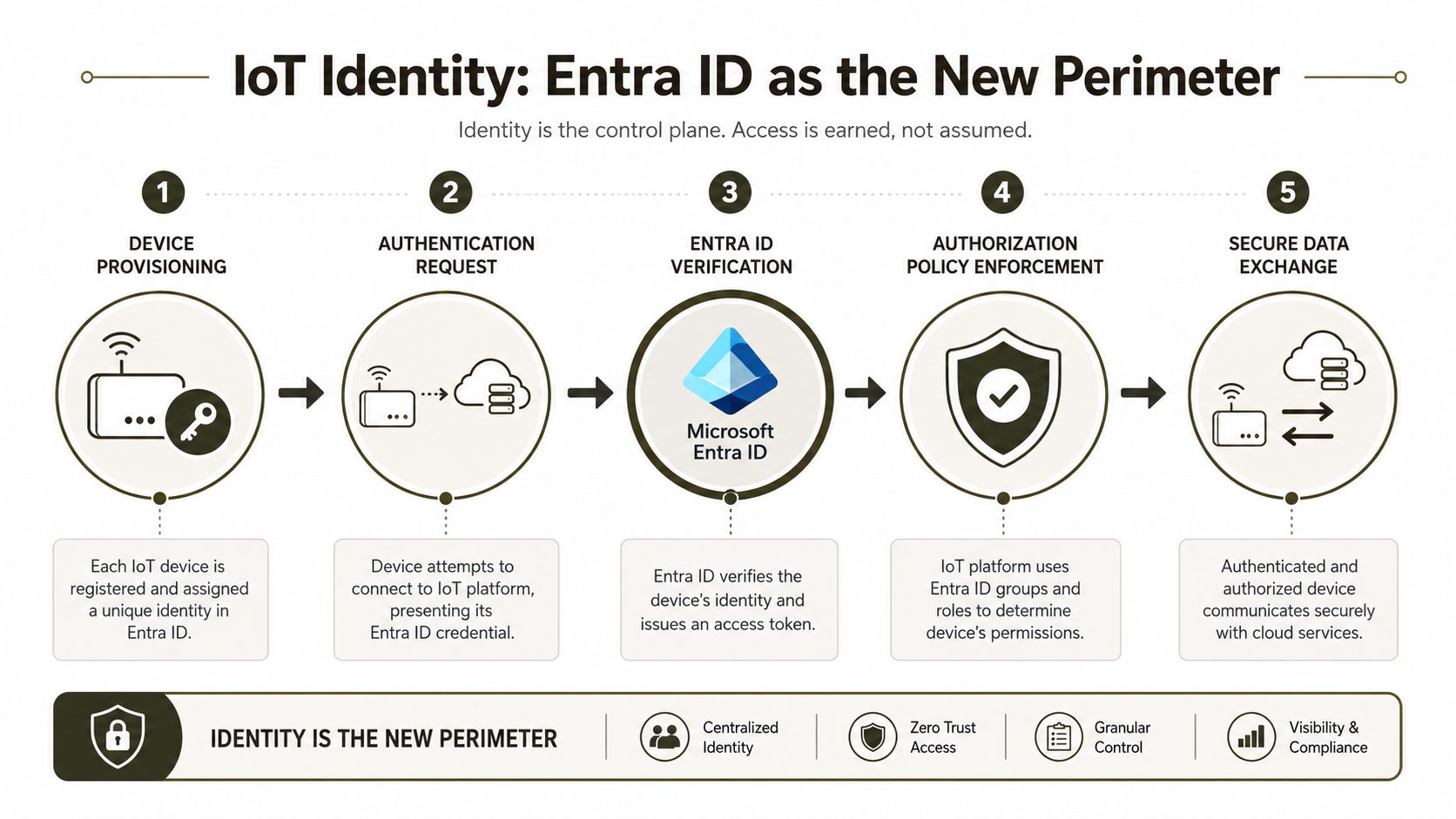
Network boundaries won't save your IoT estate. Devices move. Gateways get replaced. Services scale out. Connectors multiply. The only perimeter that still holds under pressure is identity, and most enterprise IoT programmes handle identity badly.
That's reckless in regulated environments.
The breach pattern nobody wants to admit
Within regulated Irish sectors, 68% of IoT-related breaches stem from unmanaged identity integration rather than device flaws, according to Trafalgar Wireless on IoT in healthcare. That should change your design priorities immediately.
The problem isn't that teams ignore authentication entirely. The problem is that they implement fragments of it. A device gets registered somewhere. A service principal gets broad permissions somewhere else. A downstream SharePoint or Microsoft 365 process trusts the wrong token path. Then everyone acts surprised when telemetry lands with too much access or no accountability.
The five places identity breaks
Provisioning gets treated as inventory
Registration alone isn't enough. A record in a system isn't a trust model.Authentication lacks context
Devices authenticate, but policies don't consider role, purpose, environment, or ingestion route.Authorisation is too broad
Teams grant service principals access to libraries, sites, or storage scopes they never needed.Lifecycle control is weak
Devices retire. Projects end. Certificates and app permissions often don't.Business systems trust technical identities blindly
That's where M365 estates get contaminated. The data is accepted because the pipe worked, not because the trust chain was sound.
If your Entra ID design can't answer who this device is, what it may write, where it may write it, and when that right expires, you don't have Zero Trust. You have optimism.
What strong Entra ID integration looks like
A serious design ties device and service identities to policy, not convenience. That means unique principals, controlled scopes, conditional access patterns where applicable, and narrow write paths into business repositories.
It also means resisting the temptation to collapse all machine interactions into one integration account. That shortcut saves time in a pilot and creates a forensic nightmare in production. Your team needs separation between device registration, brokered application actions, and downstream data writers.
For organisations rebuilding this properly, Microsoft Entra ID strategy sits at the centre of the design, not off to one side as an IAM afterthought.
The Ollo Verdict
Treat identity as your primary control plane. If your IoT initiative touches SharePoint, Microsoft 365, or regulated workflows, Entra ID isn't optional plumbing. It is the architecture. Build around it early or prepare to rebuild it under pressure later.
Taming Telemetry Data Governance and Scale in Microsoft 365
At this point, a lot of internet of things solutions become fiction. The business asks for telemetry in familiar tools. Someone suggests SharePoint lists, document libraries, Power Automate, maybe a dashboard layer. It sounds efficient because users already know Microsoft 365.
Then the platform starts enforcing reality.
The limit that catches teams first
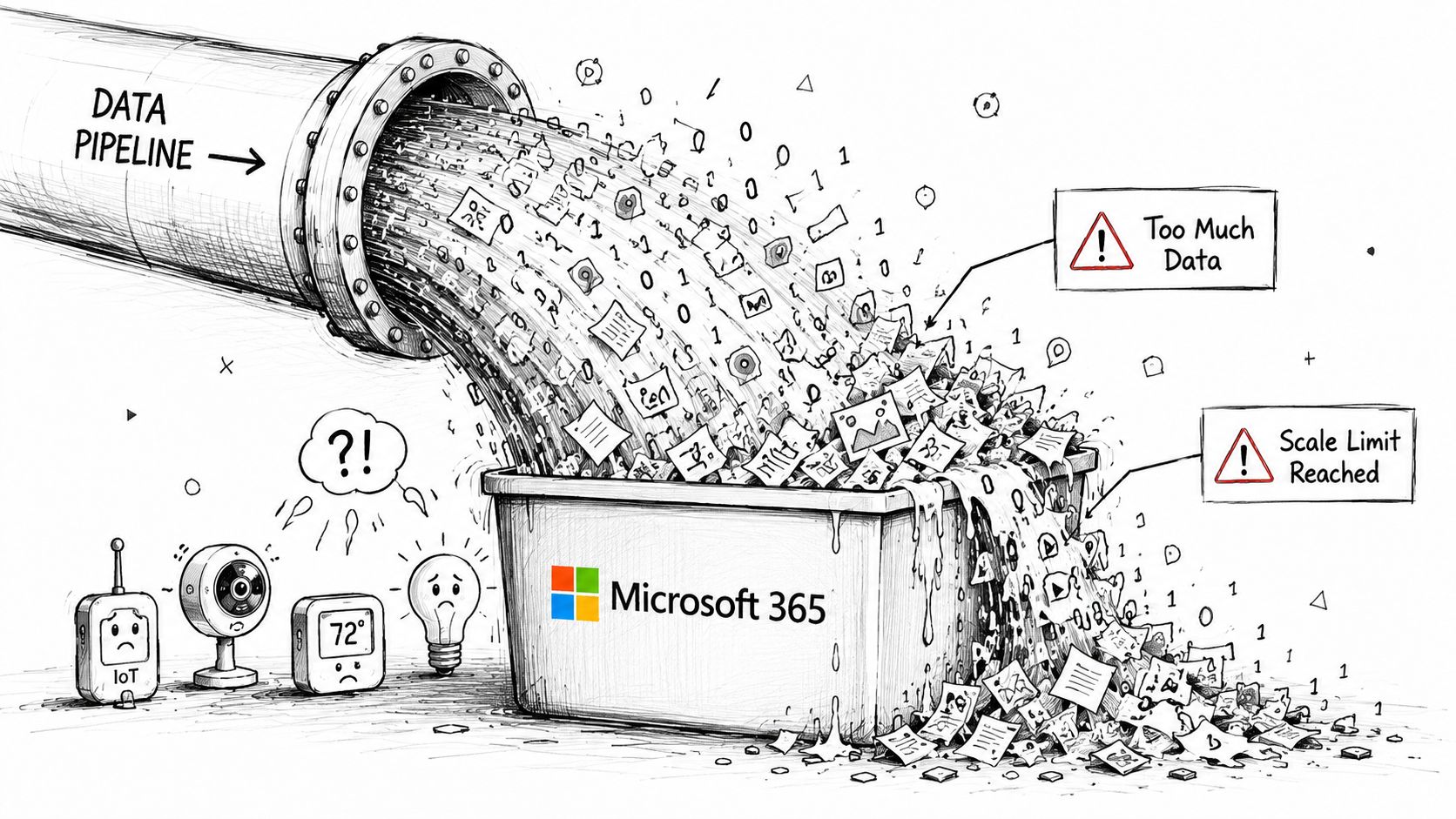
Microsoft SharePoint Online enforces a hard 5,000-item list view threshold that blocks standard queries, and that limitation is confirmed in Microsoft Learn documentation as cited by IT GOAT's migration pain points summary. This isn't a minor tuning issue. It's one of the most common reasons telemetry-driven designs break once volume becomes real.
The documentation says indexed columns and filtered views can help. That's true in narrow scenarios. Reality is that enterprise telemetry often arrives with awkward schemas, unpredictable query patterns, and retention obligations that make simplistic list design untenable.
Why Microsoft 365 becomes the wrong first destination
SharePoint and Microsoft 365 are excellent at governed collaboration, records, case context, and business process orchestration. They are not raw telemetry sinks. When teams ignore that distinction, they create several predictable failures.
- Queries stop behaving: Lists cross threshold limits and standard retrieval patterns break.
- Automations degrade: Flow logic that looked fine in a test tenant starts timing out or misfiring under load.
- Permissions become fragile: Large, rapidly changing data structures expose broken inheritance and over-permissioning.
- Retention gets messy: Teams keep everything “just in case” and then discover they can't manage it cleanly.
The documentation gap
We often see clients fail when they take Microsoft documentation at face value and operationalise it without stress testing. The documentation says a supported method exists. In reality, supportability and survivability are not the same thing.
A threshold workaround on paper doesn't mean your operational queries will remain stable. A migration path in documentation doesn't mean your tenant-to-tenant consolidation won't trigger GUID conflicts, path issues, or permission corruption when telemetry-related structures come across with legacy baggage.
Field lesson: Curate telemetry before it reaches Microsoft 365. If you land only governed, business-relevant slices, the platform remains useful. If you land the firehose, you'll spend your project cleaning up your own ingestion decisions.
What disciplined governance looks like
The right model usually includes:
| Governance concern | Safe approach | Reckless approach |
|---|---|---|
| Telemetry landing zone | Use a proper data platform first, then publish curated outputs | Write raw event streams straight into SharePoint |
| Metadata design | Keep columns deliberate, indexed where needed, and aligned to access patterns | Create catch-all lists and hope search will save you |
| Permissions | Inherit where possible, break inheritance only with reason and review | Custom permissions everywhere |
| Retention | Map legal and operational value before ingestion | Store everything indefinitely |
The ugly truth is that Microsoft 365 often sits best as the governed consumption layer, not the ingestion tier. SharePoint libraries and lists can absolutely support IoT-adjacent business processes, but only after engineers shape the data properly, limit object sprawl, and script around known platform constraints where needed.
The Ollo Verdict
Use Microsoft 365 for governed business context, controlled workflows, and curated operational visibility. Don't use it as a raw telemetry dump. If your design depends on ignoring the 5,000-item threshold, API throttling behaviour, or path and inheritance risks, the design is already broken.
The Tooling Deception SPMT vs ShareGate vs Custom Scripts
Tool choice doesn't rescue bad architecture, but the wrong tool will absolutely finish off a fragile project. Consequently, a lot of IT leaders get misled. They see a Microsoft tool, a respected third-party tool, and assume the difference is convenience. It isn't. The difference is where each one breaks.
Tooling Reality Check for Enterprise IoT Data
| Tooling Approach | Best Suited For | Enterprise Breaking Point |
|---|---|---|
| SPMT | Small, straightforward migrations with limited complexity | Struggles when structure, permissions, and volume create throttling, remapping, or remediation needs |
| ShareGate | Managed migration projects that need stronger control and reporting | Still needs disciplined design and won't magically solve deep inheritance, GUID, or tenant consolidation problems |
| Custom PowerShell PnP scripts | Complex remediation, staged transformation, and exception handling | Fails only when the team writing the scripts doesn't understand the platform deeply enough |
SPMT has a place. It's a utility, not a strategy. The documentation says it supports migration scenarios well enough, and for small jobs that's fair. But when telemetry-related data structures, permissions issues, or regulated retention requirements enter the picture, SPMT runs out of road quickly.
ShareGate is stronger. It gives better control, better visibility, and better handling for serious migration work. But even ShareGate isn't a silver bullet. We often see clients fail when they assume premium tooling can compensate for weak pre-migration analysis. It can't. If your source estate has broken inheritance, malformed metadata, legacy sprawl, or identity confusion, the tool will carry those problems forward at speed.
The problem no tool solves for you
No off-the-shelf tool understands your governance intent. No wizard knows which telemetry-derived structures should be consolidated, archived, remodelled, or excluded. No checkbox resolves the political and technical mess of tenant-to-tenant collision risk.
If your team is evaluating Microsoft's native path, SharePoint Migration Tool considerations are worth reviewing with a sceptical eye. The key question isn't whether the tool can move files. It's whether it can preserve a regulated operating model without creating hidden defects.
The Ollo Verdict
Use SPMT for small, low-risk moves. Use ShareGate for controlled enterprise migrations. For anything involving tenant consolidation, telemetry-linked data, broken inheritance, GUID conflicts, or compliance-sensitive restructuring, you need custom scripting. Without that, you're not managing migration risk. You're outsourcing it to chance.
The Only Safe Path for High-Stakes IoT Integration
The dangerous myth in internet of things solutions is that value comes from connectivity. It doesn't. Value comes from controlled integration. Devices, gateways, analytics, identities, permissions, and Microsoft 365 governance all have to hold together under stress. If one layer fails, the whole programme becomes suspect.
That's why DIY is such a bad bet in regulated estates. Your risk doesn't sit in one dramatic failure. It accumulates in small technical shortcuts: broad service principals, poor telemetry modelling, weak gateway policy, careless SharePoint design, and tooling decisions that ignore scale. Then one audit, one migration event, or one ingestion surge turns those shortcuts into a business problem.
The safest path is narrow. Architect for latency where operations demand it. Secure the chain, not just the device. Make Entra ID the control plane. Keep raw telemetry out of Microsoft 365. Use tools for what they're good at, then switch to custom engineering before the platform pushes back.
That isn't overengineering. It's risk reduction.
If your organisation is dealing with high-stakes IoT integration, regulated Microsoft 365 data, or a migration that already feels unstable, talk to Ollo. We handle the rescue work most firms don't want: complex tenant consolidations, Entra ID redesigns, SharePoint remediation, and migrations where failure would damage compliance, operations, or both.