


Most advice about electronic commerce services starts in the wrong place. It starts with the storefront, the catalogue, and the checkout skin, then pretends the hard part is design. That's how enterprise teams end up with a pretty front end sitting on top of brittle payments, weak identity controls, broken order states, and compliance drift that nobody notices until an auditor or a customer finds it first.
If your organisation treats electronic commerce as a marketing channel, you'll inherit operational debt. If you treat it as transactional infrastructure, you can design for resilience, auditability, and controlled change. That difference matters more than vendor brochures admit, because e-commerce is now mainstream in the EU, not an edge case. Eurostat shows the share of enterprises with e-sales rose from 17.21% in 2013 to 23.83% in 2023, and turnover from e-sales increased from 13.81% to 19.12% over the same period, though 2023 still sat 0.71 percentage points below the 2019 peak (Eurostat e-commerce statistics).
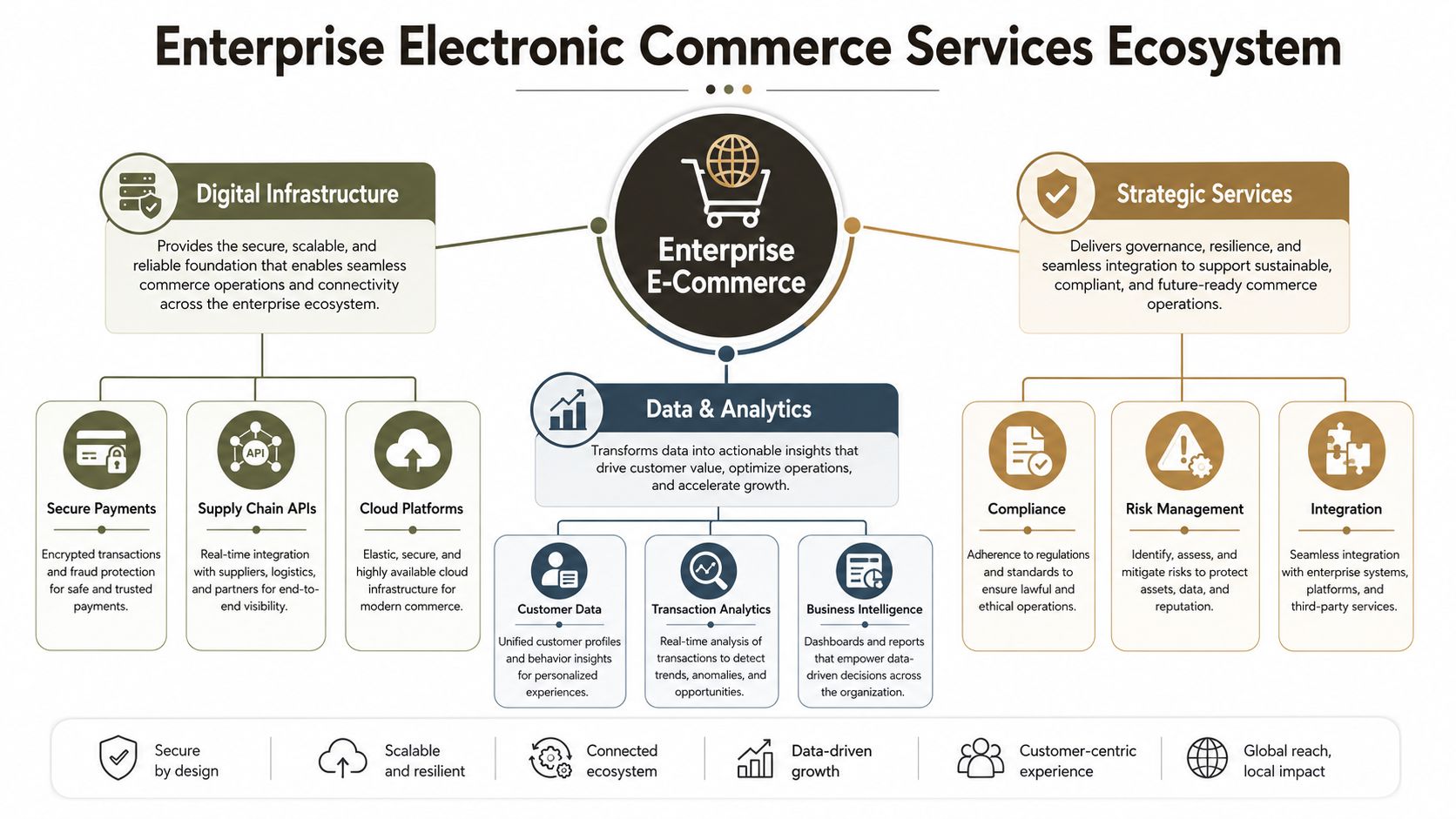
What Electronic Commerce Services Actually Mean for Enterprise
The retail crowd talks about product pages and shopping baskets. Enterprise IT has to think about payments, order state, fulfilment orchestration, marketplace integrations, and system interoperability. That's the shape of electronic commerce services, especially when regulated data and audit trails have to survive every handoff.
Eurostat's glossary defines e-commerce as the sale or purchase of goods or services through electronic transactions over the internet or other computer-mediated networks, across businesses, households, individuals, and private organisations (Eurostat glossary). That definition should change how you scope projects. You are not just building a store, you're building a transaction layer that can span supplier portals, internal ordering, B2B exchange, and customer-facing purchase flows.
The enterprise reading is infrastructure first
NIST's model is the cleanest way to think about the stack. The core components are communications, data management, and security, with security covering authentication, integrity checking, confidentiality control, and recipient verification (NIST SP 500-218). If one layer fails, the whole transaction chain breaks. A payment that can't authenticate properly, an order that loses state, or a message that arrives altered is not a small glitch. It's a failed business process.
Practical rule: if a vendor only talks about storefront features, they're hiding the systems you'll actually have to run.
That is why the right mental model is boring in the best possible way. Communications services move trusted messages. Data services keep transaction records consistent. Security services make sure the right party sent the right thing and nobody tampered with it. Once you hold that line, product catalogues and UI components stop looking like the centre of the system, because they aren't.
For a useful adjacent read on cross-border complexity, the cross-border payment processing guide is worth keeping close. And if you're already thinking about back-office control, the internal guide on electronic invoicing software shows how the finance layer and commerce layer often collide in the same workflows.
What that means in practice
Payment services depend on communications and security. Storefront services depend on communications and data management. Order management bridges all three because it has to reflect what the customer saw, what the payment rail accepted, and what fulfilment can still ship. Fulfilment, marketplace syndication, and integration services sit at the intersection of all of them, which is why one broken connector can ruin the entire transaction chain.
If you only fund the customer-facing layer, you'll ship something unstable and call it digital transformation. If you fund the stack as infrastructure, you get something that can survive real enterprise traffic, real reconciliation, and real governance.
The Core Components of Electronic Commerce Services
The cleanest way to break this problem down is to stop asking which vendor is best and start asking which pillar is failing. NIST's framework gives you the answer. Communications, data management, and security form the foundation, and everything else is just a service wrapped around those fundamentals (NIST SP 500-218).
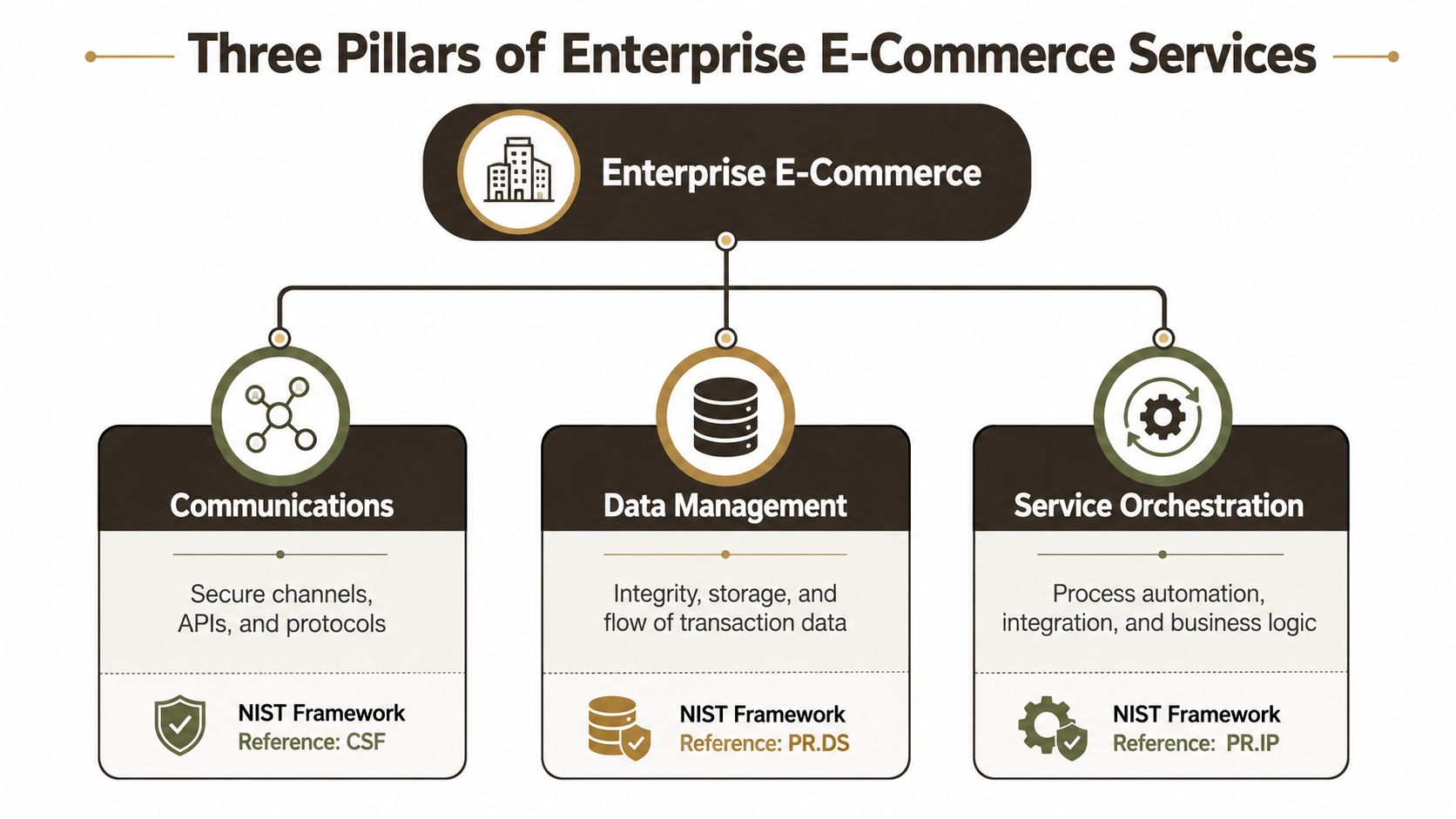
Communications carries the transaction
Communications is not just “the internet works”. It's authenticated transport, message integrity, and reliable handoff between systems. In commercial terms, this covers API gateways, message buses, secure transport layers, and the glue that lets order, payment, and fulfilment systems talk without drifting out of sync.
If communications fails, your platform can still look live while dropping transactions or duplicating them. That is where enterprise teams get burned, because the storefront appears fine until reconciliation exposes the gap. In a regulated environment, that gap becomes an audit problem as soon as a transaction cannot be proven end to end.
Data management keeps the business state intact
Data management holds transaction records, customer data, order status, and the relationships between them. This is the layer many teams underestimate during procurement. They buy a shiny commerce front end, then discover that their data model can't support the order history, fulfilment traceability, or reporting they need.
Hard rule: if your order state cannot be trusted, your commercial platform is already failing.
That is why platform design has to treat data as operational infrastructure, not a reporting afterthought. Search, product detail, customer records, and fulfilment views all pull from the same truth source. If that source fragments, every department starts keeping its own version of the story.
Security enforces trust
Security in this stack means authentication, integrity checking, confidentiality control, and recipient verification. That maps directly to payment services, identity services, and sensitive customer or supplier data flows. The risk isn't abstract. The wrong payload, the wrong recipient, or the wrong trust boundary turns a transaction system into a liability.
The OECD frames electronic and mobile commerce as part of a broader digital transaction stack, where firms use online commerce to reduce transaction costs and expand market reach, while still facing trust, security, and implementation barriers (OECD digital economy work). That's the point enterprise leaders should keep in view. The upside is real, but only if the underlying stack can carry trust all the way through.
For the workflow side of this picture, the internal guide on digital transaction management is the right companion piece. It makes the bridge between commercial flow and controlled process much easier to see.
Technical Security and Compliance Risks in Regulated Sectors
Regulated sectors don't get to shrug at checkout problems and call them UX. They get audited. They also tend to inherit the worst possible version of electronic commerce services, because they need payments, order management, fulfilment, and marketplace integration to work together without breaking identity, accessibility, or record retention.
The core risk register starts with the stuff vendors don't like to discuss. API throttling during peak load is one of them. The documentation says the platform scales, but reality is that a burst of order writes, fulfilment calls, or payment callbacks can hit service limits right when the business needs stability most. At that point, your cart isn't the issue. Your transaction chain is.
Where the failures show up first
We often see clients fail when they assume the checkout layer is the only critical path. It isn't. Broken inheritance in permissions, long path limits, and GUID conflicts during consolidation can wreck migration integrity and leave records in a state nobody can confidently audit. Microsoft's official documentation covers these limits and behaviours in SharePoint and Microsoft 365, and you should treat them as hard constraints, not optional trivia. Ignore them and you risk a migration that technically completes but operationally fails.
The accessibility problem is just as blunt. Recent guidance and research show that checkout is the highest-risk path because third-party payment processors and interactive widgets often break compliance and conversion at the same time (UNCTAD digital economy report). If your payment flow blocks assistive tech, your platform isn't merely inconvenient. It's excluding customers and creating legal exposure.
The documentation says “broad inclusion”. In reality, last-mile delivery, returns handling, and support channels are where smaller organisations break first.
Inclusion failures are usually payment failures
A frequently missed issue is payment inclusion for low-access households and small merchants, especially in Ireland and Northern Ireland. Research on underserved digital payments says households are underserved when they rely on unsafe, high-cost, or paper-based payment methods for a significant share of transactions, and global development work flags the same bottlenecks for e-commerce access, including internet affordability, lack of electronic payment means, and weak communication infrastructure for online payment facilities (Boston Fed working paper). That's not a storefront problem. That's a rails problem.
If your commerce design assumes everyone has reliable card access, digital trust, and stable connectivity, your platform will systematically exclude rural, elderly, disabled, and otherwise underserved users. More checkout options don't fix that. Sometimes they just create a more polished form of exclusion.
Operational debt hides in the back office
The other failure point is boring, which is why teams miss it. Returns, post-sales support, and delivery economics create the hidden operational debt that kills smaller or regulated organisations. If the documentation says broad access is the goal, the last mile and service model determine whether the platform is usable.
For readers who need the VAT and compliance angle in a SaaS context, the Creem SaaS VAT compliance tips are a useful reminder that tax, records, and commerce flow tend to collide in the same system boundaries. If your organisation handles healthcare data as well, the internal guide on HIPAA compliance requirements shows how fast a commerce workflow can become a compliance workflow.
Integration and Migration Challenges with Microsoft 365 and Entra ID
The moment you move commerce operations into Microsoft 365 and SharePoint, this stops being a theory exercise. Tenant-to-tenant migration exposes every weak assumption in your order, payment, and service data flows. If your team treats that as a copy job, you'll break continuity somewhere you can't afford to break it.

The failure modes are predictable
API throttling becomes a migration blocker when thousands of ordered items, attachments, or supporting records have to flow through SharePoint lists during consolidation. The issue is not performance in the abstract. It's transaction continuity under load. If the service throttles at the wrong point, your records land out of sequence or incomplete.
The 5000-item list view threshold is another one. Microsoft documents it clearly, and it matters because teams love to discover it after they've already dumped operational data into a list that now refuses to behave. Broken inheritance creates similar pain. If you need audit trails and retention labels to survive the move, permissions that drift during migration are not a cosmetic problem. They are a control failure.
Identity is the real migration boundary
Entra ID changes make this more dangerous, not less. If your organisation redesigns identity at the same time it changes tenants, you're not just mapping users. You're remapping trust, access, and service ownership. That is where zero-trust assumptions either hold or collapse.
We often see clients fail when they try to migrate commerce data without aligning identity objects, service accounts, and downstream app permissions first. The result is orphaned access, broken workflows, and post-migration tickets that never stop arriving. The documentation says identity migration is manageable. Reality is that every commerce integration carries hidden dependencies on roles, claims, and access patterns.
For a direct primer on the identity side, the internal guide on Microsoft Entra ID is worth reading before anyone signs off on a redesign. If you're mapping platform access into venues, guest Wi-Fi, or partner portals, the secure Azure WiFi for hotels example is a useful reminder that identity design affects more than just employees.
The Ollo Verdict on migration tooling
SPMT has a place, but it's narrow. Use it for small, low-risk migrations under 50GB. Anything involving regulated commerce data, marketplace integrations, Entra ID redesign, or operational records that must preserve control boundaries needs ShareGate and custom PowerShell PnP scripting. A generic tool can move files. It cannot think through dependency chains, retry strategy, or the control failures that appear after go-live.
If you want to understand why consultant-led governance beats admin-only execution here, the internal comparison on Microsoft 365 admin vs consultant is the right lens. The short version is simple. DIY looks cheaper until the first failed cutover, then it gets expensive fast.
Buy Build or Hire an Expert Decision Framework
The argument becomes practical here. You have three paths, and only one of them consistently survives regulated commerce complexity without creating a hidden incident backlog.
Compare the three paths against the risks that matter
| Path | Compliance readiness | Identity and security integration | Data migration complexity | Time to resilience | Total cost of failure |
|---|---|---|---|---|---|
| Build in-house | Usually weak at first, because teams underestimate governance, accessibility, and retention controls | High effort, especially when payment, order, and Entra ID dependencies spread across systems | High, because your team has to design, test, and support everything | Slow, because your architects become the support desk | Very high, because defects become your liability |
| Buy a commercial platform | Better baseline controls, but often limited by vendor assumptions and lock-in | Medium to high, depending on connector quality and identity flexibility | Medium, until you need edge-case migration or consolidation | Faster to launch, slower to adapt | High, because lock-in makes remediation expensive |
| Hire a specialist | Strongest fit for regulated work, because the service model starts with risk containment | Strong, because identity, security, and platform integration get designed together | Controlled, because the work includes mapping, scripting, testing, and rollback discipline | Fastest path to stable operation | Lowest, because failure points get managed before cutover |
The buy path looks attractive until your environment needs something the vendor roadmap doesn't cover. Then you inherit integration debt, and the vendor sells you another module. The build path gives you control, but control without migration discipline just means you own every defect forever.
Score the decision on five criteria
Use these five filters before you sign anything:
- Compliance readiness. If the platform can't preserve records, access, and audit evidence, you're not ready.
- Identity and security integration. If Entra ID, payment identity, or downstream app claims don't map cleanly, stop.
- Data migration complexity. If your order history, product data, or fulfilment records need special handling, generic tooling won't save you.
- Time to resilience. If you need the platform to survive real traffic quickly, don't choose a path that requires months of post-launch repair.
- Total cost of failure. Missing a migration step doesn't just fail the project, it breaks legal compliance, service continuity, and customer trust.
Decision rule: if your team can't describe rollback, audit preservation, and identity mapping in one meeting, it's not ready to own the migration.
The honest answer is that DIY only works when the surface area stays small and the data stays simple. Once regulated commerce, multi-system integration, or identity redesign enters the picture, “we'll manage it internally” turns from brave into negligent. The internal guide on why Microsoft 365 admin work differs from consultant-led delivery makes that distinction plain.
Risk Reduction Checklist and the Ollo Verdict
A serious migration or consolidation review should start with controls, not enthusiasm. If your team skips the control work, the project will still move forward. It'll just move forward with blind spots, and those are the ones that cause the incident reports later.
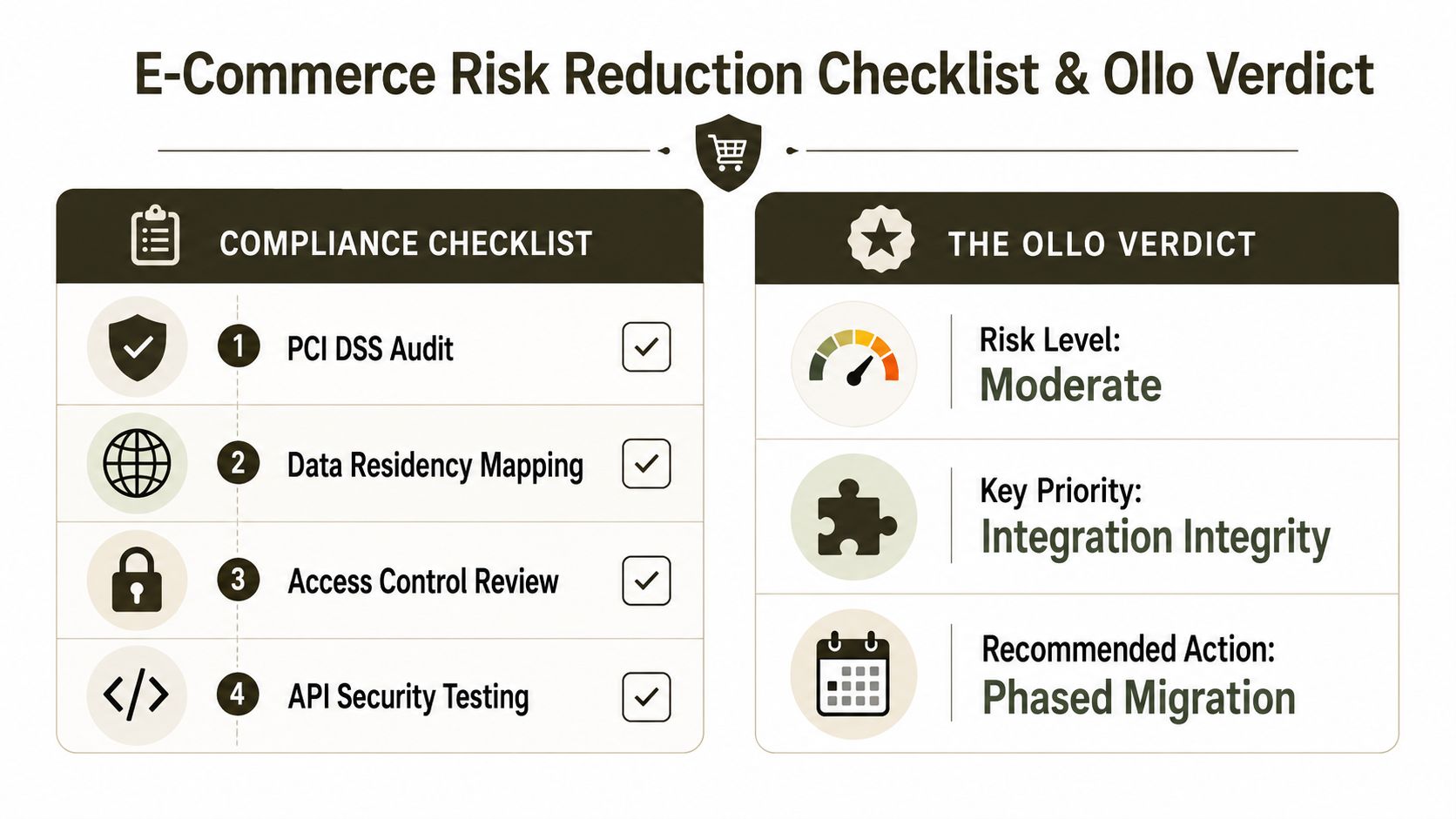
Your checklist before any migration or platform change
- Compliance validation first. Verify that records, retention, and access controls still hold after the move. If the platform can't prove it, don't launch it.
- Identity mapping for Entra ID. Confirm zero-trust roles, service accounts, and downstream permissions before cutover.
- Payment and checkout accessibility testing. Test browsing, cart, and payment flows with third-party widgets in place, not in a lab fantasy.
- SharePoint threshold and inheritance checks. Validate list behaviour, permission inheritance, and record visibility before users hit the system.
- Fulfilment integration continuity. Rehearse order handoff, status updates, and failure recovery, because the front end means nothing if the back office stalls.
The point of this list is simple. Don't measure success by whether the site looks live. Measure it by whether the commerce process still works under audit, under load, and under failure.
The Ollo Verdict is blunt. For low-risk, small-scale migrations under 50GB with no regulated data, SPMT may suffice. For enterprise consolidations, multi-tenant merges, Entra ID redesigns, or any commerce data migration in energy, finance, or healthcare, hiring a specialist migration consultancy is the only credible risk-reduction strategy. Anything less is a gamble with your data, your audit trails, and your customer trust.
If you want a proper assessment before your next architecture review, get one from Ollo and use Ollo to put your commerce migration, identity state, and compliance evidence under a team that's done this before. Your data deserves a safe pair of hands, not another post-mortem.