


Monday morning, the procurement team says the critical shipment has cleared the supplier. The warehouse system shows no usable stock. Transport has a booking, but the order record carries a different reference, and finance can't confirm whether the supplier invoice matches the agreed purchase order. By the time someone reconciles three spreadsheets, an email trail, and a legacy SharePoint list, the delivery window has become a compliance problem rather than a logistics problem.
That failure doesn't start with a missing dashboard. It starts with disconnected control points, weak master data, and an implementation team that treats supply chain software as a feature purchase. Ireland's operating environment makes that mistake particularly expensive. Foreign value-added accounted for 43.8% of Irish exports, almost six times the OECD average of 7.4%, according to the Irish government's Expert Group on Global Value and Supply Chains report, available through this Ireland supply chain software market reference. The same report says 47% of enterprises purchased goods or materials from abroad in 2020, while 35% purchased services, and major supplier regions included the UK and EU.
Your software therefore has to control handoffs across procurement, inventory, transport, suppliers, compliance, and customer service. A bad decision can corrupt the evidence trail, hide a stock exception, break access controls, or leave regulated teams unable to prove what happened. This guide takes the position that disaster avoidance matters more than a polished demonstration. The right platform is the one your team can integrate, govern, test, monitor, and recover under real operational pressure.
Introduction Why Supply Chain Software Decisions Go Wrong
A supply chain failure rarely looks dramatic at first. One supplier updates a delivery date in an email. A planner changes a spreadsheet. A warehouse supervisor works from yesterday's export, while the transport team uses a carrier portal that doesn't feed the order system. Each person sees a plausible version of reality, and nobody owns the contradiction.
That operating model survives while volumes remain manageable and exceptions stay rare. It collapses when a shipment affects a patient, an energy project, a financial control, or a customer commitment. Your team then discovers that visibility wasn't the same as control. The dashboard displayed information, but no workflow assigned the exception, preserved the decision trail, or stopped the next process from acting on stale data.
Ireland's technology base raises the standard further. The Central Statistics Office reported €128bn of ICT industry output in 2019, with foreign firms accounting for €122bn, or 96%, and the sector generating €51bn in gross value added, as documented in this CSO-based overview of Ireland's technology ecosystem. Total ICT exports reached €117bn in 2019. Those figures describe an economy accustomed to complex digital operations, not a market where enterprise teams can excuse brittle integrations as a temporary inconvenience.
Practical rule: If procurement, warehouse, transport, and compliance teams can't agree on the authoritative record, your software isn't providing supply chain control.
The downstream cost of failure extends beyond delayed goods. Broken permissions can expose sensitive supplier or patient information. Incomplete migration can remove evidence required for an audit. A failed integration can trigger manual workarounds that bypass approval controls. A project that appears to save implementation effort can create legal, operational, and reputational exposure after go-live.
The useful question isn't which product has the longest module list. Ask whether the platform can represent your operating model, connect to your existing systems, handle exceptions, enforce ownership, and preserve an auditable history. The sections that follow focus on that risk surface, because the dangerous failures usually appear after the demo.
What Supply Chain Software Really Is Beyond Tracking
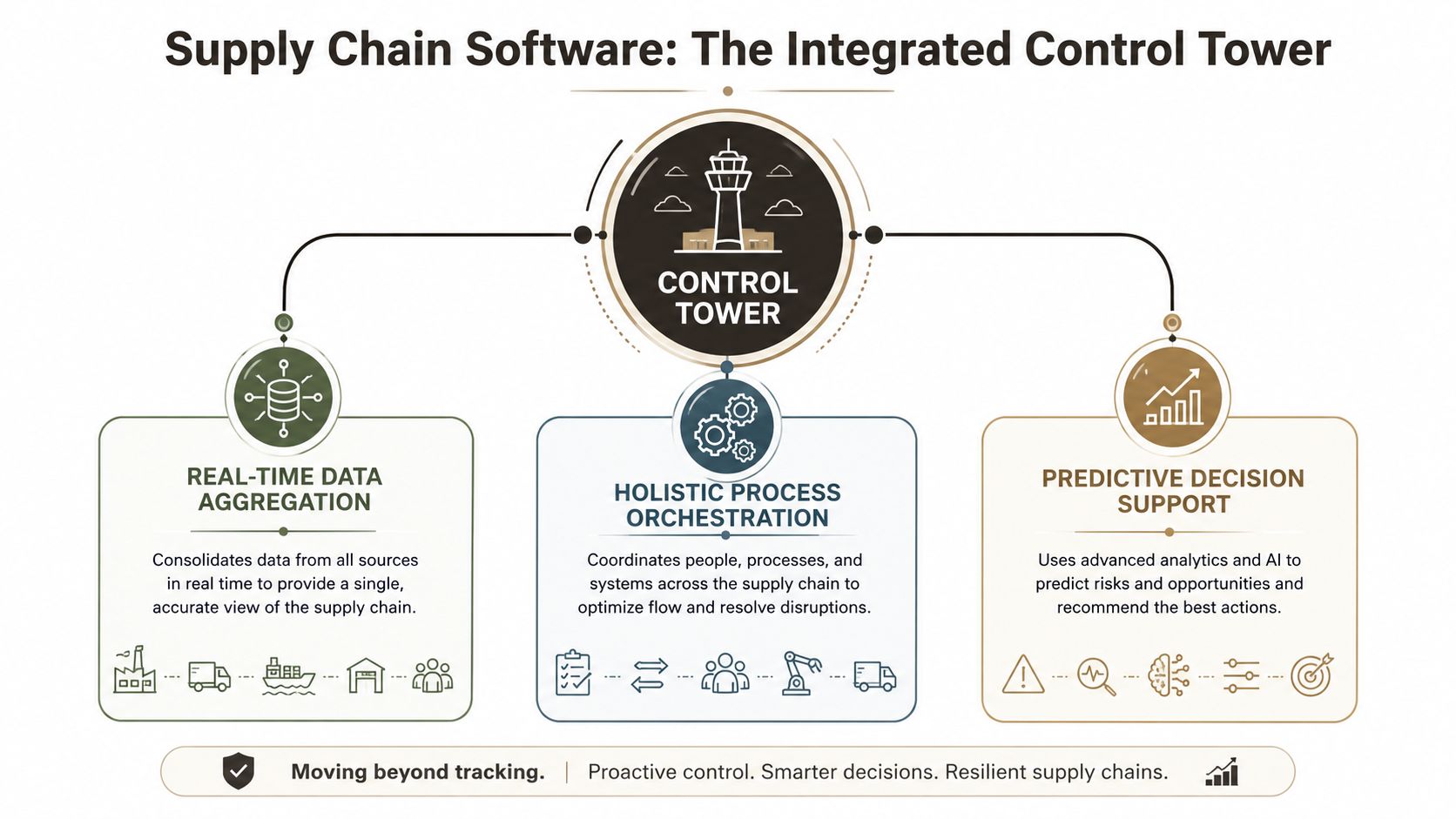
Supply chain software is a control plane for operational decisions, not a map with moving icons. A tracking tool can tell you where a shipment is. A supply chain platform should help your team decide what to do when the shipment is late, the available inventory is reserved elsewhere, the supplier record conflicts with the purchase order, or a regulated handoff lacks evidence.
Think of the difference between a control tower and disconnected walkie-talkies. Walkie-talkies let teams exchange updates, but each group still keeps its own notes and interprets the message through its own process. A control tower aggregates signals, applies rules, assigns action, and records the decision. That distinction defines whether your system delivers visibility or operational control.
Start with the operating signal
Your first requirement is a trusted flow of data from procurement, suppliers, warehouses, assets, transport providers, and finance. That doesn't mean every record must live in one database. It means each record needs a defined owner, a reliable identifier, a synchronisation pattern, and a rule for resolving conflicts.
A purchase order system illustrates the point. If the order exists in an ERP, the supplier portal, an email attachment, and a Microsoft 365 list, your platform needs to identify which version controls the next action. Guidance on purchase order systems is useful here because purchase orders often sit at the intersection of procurement approval, inventory commitment, delivery scheduling, and invoice matching.
Turn information into action
An integrated platform should convert events into workflows. A late supplier confirmation might create an exception for procurement, recalculate an expected receipt for inventory, notify transport planning, and preserve the approval trail. A temperature or asset alert might require escalation rather than another unread notification.
That orchestration separates a serious execution stack from a collection of point tools. Research on supply chain digitalization by Blocsys Technologies provides useful context on how connected systems move organisations beyond isolated operational records. The practical test remains yours: can the platform prove who saw an exception, who accepted the risk, and what changed afterwards?
Design for auditability
Visibility without governance creates false confidence. Your data model should preserve source references, timestamps, ownership, approval states, and changes to critical fields. Access should follow role and business need, not the convenience of broad inherited permissions.
The best architecture also makes exceptions measurable. It distinguishes a genuine supplier delay from a missing integration message, and it routes each issue to someone with authority to resolve it. That is why supply chain software belongs in architecture and governance discussions, not only in logistics procurement.
Core Modules That Make Up a Modern Execution Stack
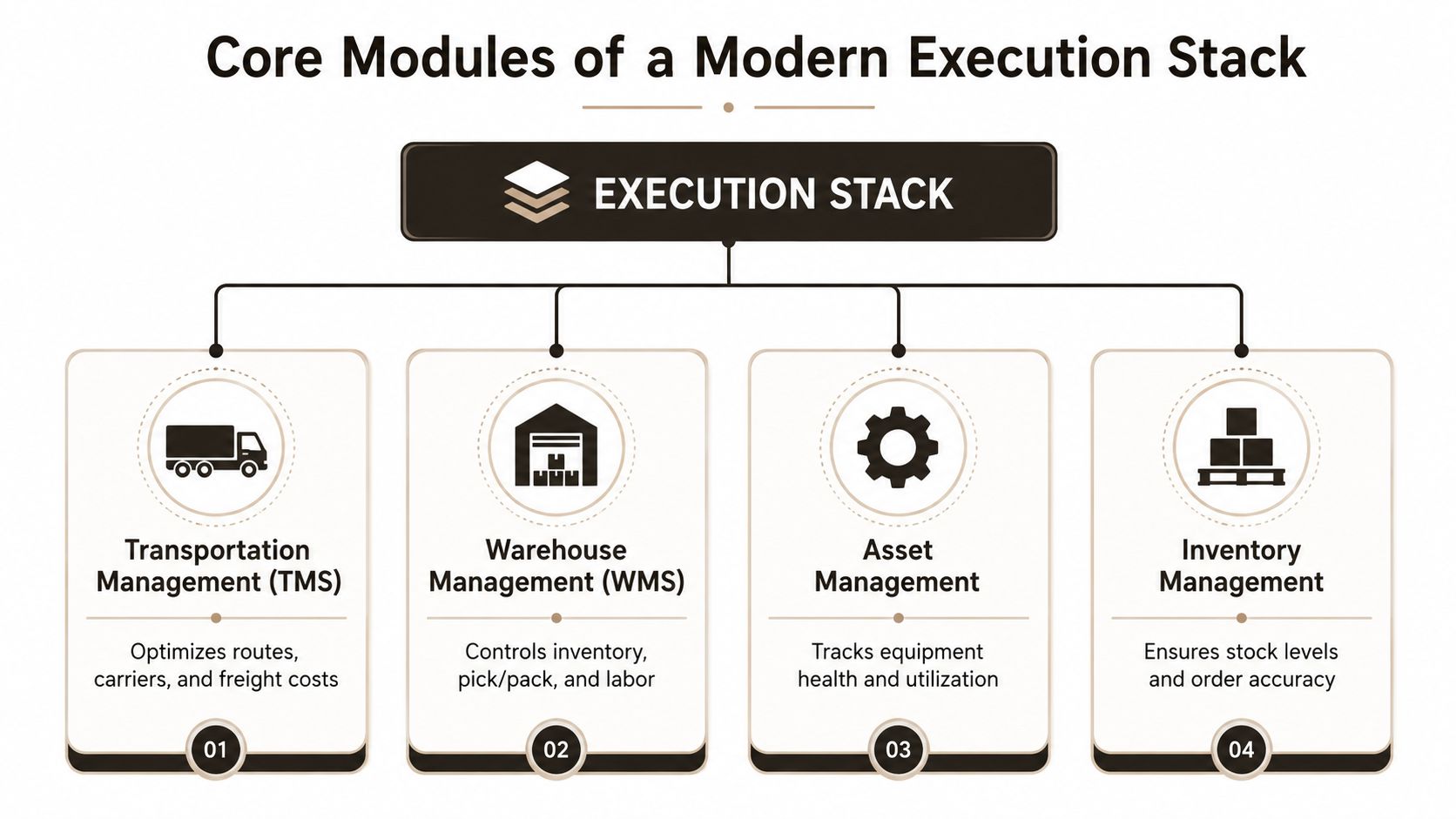
A modern execution stack combines several capabilities that share data and decision logic. Ireland's logistics software market is segmented across transportation management, warehouse management, asset and fleet management, and data management, as shown in this Ireland logistics software market outlook. Buyers should read that segmentation as an architectural warning. A module can work perfectly in isolation and still fail the operation if it cannot exchange authoritative events with the other modules.
Transportation and warehouse control
Transportation management handles carrier selection, route planning, shipment milestones, freight activity, and delivery exceptions. It should consume order and inventory status rather than forcing planners to rekey those details. If a warehouse can't confirm availability, the transport plan may optimise a delivery that cannot ship.
Warehouse management governs receiving, put-away, picking, packing, staging, and dispatch. A serious WMS connects physical movements to inventory records and order status. It also needs to support the operational controls your warehouse uses, including location logic, item constraints, scanning, and exception handling.
The integration question matters more than the screens. A TMS and WMS that exchange only nightly files won't support decisions that depend on current allocation or dispatch status. Your team needs to test event timing, retry behaviour, duplicate messages, and ownership when the source system rejects an update.
Assets, inventory, and connected telemetry
Asset and fleet management tracks equipment, utilisation, maintenance status, and operational availability. Connected logistics systems may also include warehouse IoT, predictive asset monitoring, and device telemetry. Those capabilities can improve response only when the platform distinguishes a useful event from noisy sensor output.
Inventory management maintains stock positions, reservations, replenishment logic, and order accuracy. It becomes unreliable when item, supplier, unit-of-measure, location, or batch data varies between systems. The master data management products guide is relevant because supply chain accuracy depends on definitions that remain stable across procurement, warehouse, transport, and finance.
Judge the stack by failure handling
A narrow module often looks cheaper because it avoids immediate architectural work. We often see clients fail when they buy that module and bolt the missing processes onto spreadsheets. The result is brittle orchestration, duplicated identifiers, manual reconciliation, and unclear process ownership.
Architecture test: Ask the vendor to demonstrate a rejected message, a duplicated event, a changed supplier identifier, and a warehouse exception. A polished happy path tells you almost nothing.
Kerridge's Irish distribution offering reflects the broader market expectation for software plus integration, deployment, support, and managed services, as described in its distribution software capabilities. Your evaluation should therefore score the depth of the execution model, not the number of features shown in a sales workshop.
Why Visibility Tools Fail Under Real Enterprise Load
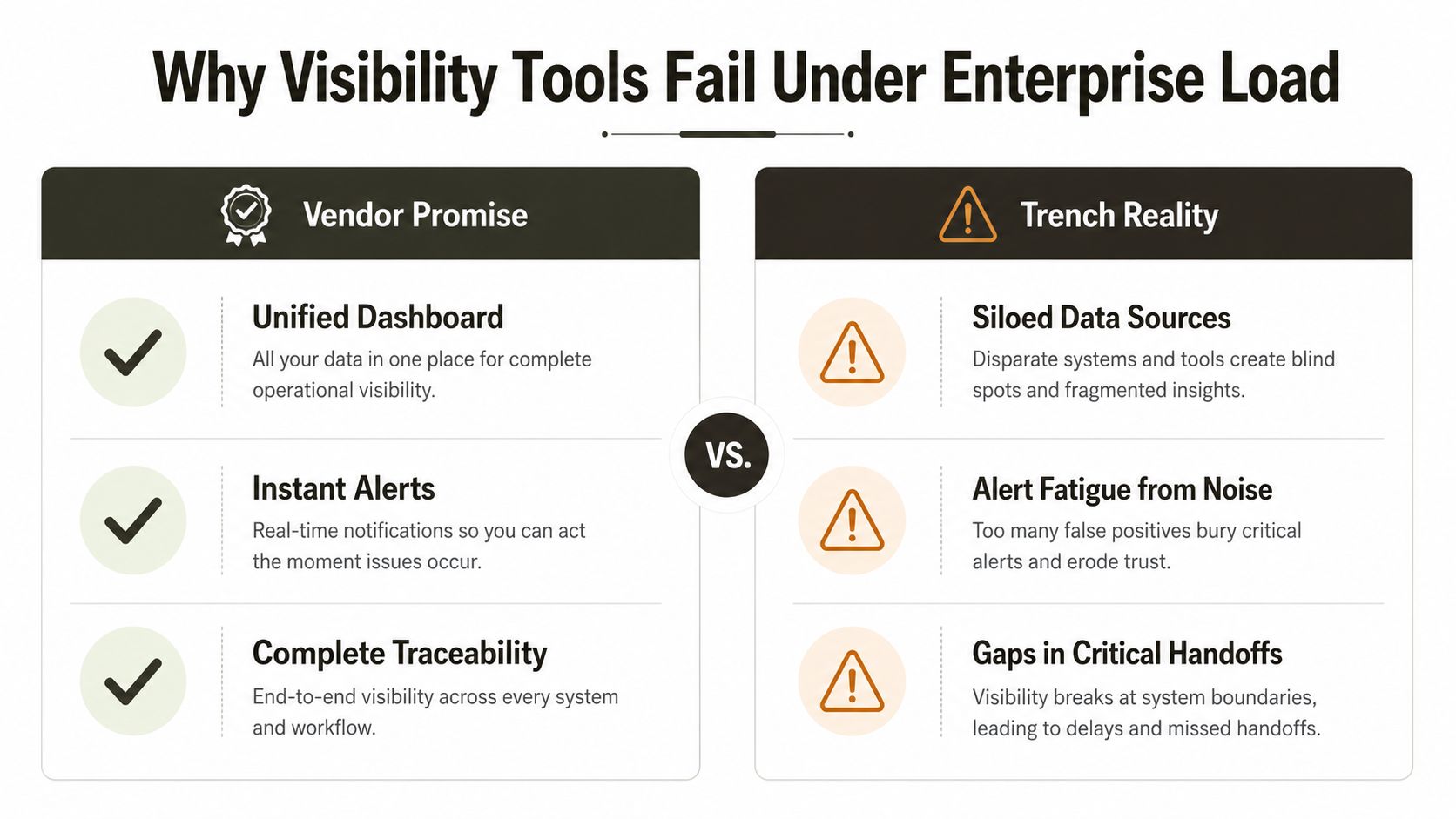
A vendor demonstration runs on clean records, short names, predictable permissions, and controlled transaction volumes. Production contains legacy folders, inconsistent identifiers, inherited access, custom fields, failed jobs, and undocumented workarounds. Visibility software exposes those conditions. It does not correct them automatically.
Irish pharma, healthcare, energy, and distributed logistics operations are assessing AI, IoT, blockchain, and digital twins for traceability and route decisions. Cloud and data analytics programmes add more events, interfaces, and control points for teams to govern. They do not remove the technical ceilings imposed by the underlying platforms.
The ceilings appear during migration
API throttling can push a healthy test integration behind once production traffic rises. Data model drift creates another failure path. A source system adds a field, changes a status value, or modifies an identifier, and the receiving workflow interprets the payload incorrectly.
Broken inheritance creates access surprises when teams copy content into a new information architecture. GUID conflicts can produce duplicate or misidentified objects when scripts assume identifiers remain unique across tenants or systems. These failures may not stop a job. That makes them more dangerous, because users continue working with data they believe is correct.
SharePoint Online applies Large List Resource Throttling with a default list view threshold of 5,000 items, and operations that exceed the threshold can be blocked. The threshold cannot be changed in SharePoint Online, according to Microsoft Learn guidance on SharePoint list view thresholds. Treat this as a platform constraint, not an implementation preference.
Path length is a hard boundary
Microsoft documents that the entire decoded file path, including the file name, cannot exceed 400 characters in OneDrive for work or school and SharePoint in Microsoft 365, as set out in the SharePoint Online limits documentation. A legacy file server may accept deep folder structures and verbose names that the target rejects.
Path remediation belongs before load. If the migration script discovers the problem after users begin working, the result can include missing content, broken links, and a disputed cutover.
The same discipline applies to analytics. A useful operational view of visibility for hauliers and container operators separates shipment status from dependable network visibility. Source validation, ownership, and recovery controls still determine whether that view can be trusted. The supply chain analytics migration approach frames migration as a control exercise rather than a dashboard exercise.
Integration Patterns and Technical Risks You Must Validate
Your integration pattern determines how quickly supply chain data becomes stale and how difficult recovery will be. Direct APIs can deliver timely events, but they require throttling controls, retries, idempotency, and monitoring. Batch files simplify source isolation, yet introduce latency and reconciliation work. Middleware centralises transformation while adding another service your team must secure, support, and test.
The danger lies in assuming a successful test proves production readiness. A test dataset rarely exercises peak request volume, duplicate messages, failed dependencies, oversized lists, or records that violate target-system rules. Validate failure behaviour before selecting the pattern.
Design around SharePoint limits
SharePoint Online applies a 5,000-item list view threshold. Operations that exceed it can be blocked, and administrators cannot raise the threshold in SharePoint Online. The large lists and libraries guidance explains the operational impact. Design indexed views, narrow queries, content partitioning, and sensible library structures before migration.
Microsoft also states that site template creation becomes blocked when lists or libraries exceed the threshold, while users may receive warnings once a list exceeds 3,000 items. During consolidation, that can prevent administrative work rather than merely slow a user view.
Compare remediation paths
On SharePoint Server, administrators can change the threshold through Central Administration. Microsoft warns that doing so can degrade performance and does not recommend it, as documented in the SharePoint Server threshold guidance. SharePoint Online provides no equivalent escape hatch.
Use three practical controls:
- Index and query redesign: Limit the records each operation touches and align views with actual user tasks.
- Content splitting: Separate high-volume operational data by business boundary, retention need, or process ownership.
- Controlled integration: Apply backoff, queueing, retry, and reconciliation logic instead of sending uncontrolled requests to the service.
Finance references need the same scrutiny as operational events. Test purchase order, goods receipt, shipment, and invoice relationships across the integration boundary. An electronic invoicing software perspective highlights why document workflows must preserve status, identity, approval, and audit evidence, rather than just transfer files.
Ollo Verdict: Do not treat SharePoint Online scale problems as a support request. Redesign the information architecture, split the content, and control the integration before cutover. Recovery discipline is part of the buying criteria.
How to Evaluate and Migrate Without Breaking Compliance
Regulated organisations shouldn't select supply chain software from a feature matrix alone. Energy, finance, and healthcare teams need evidence that the proposed design preserves access control, data lineage, retention behaviour, interface integrity, and auditability. A vendor that demonstrates screens but can't explain rollback has shown you a product, not a safe operating model.
Use evaluation gates that force the supplier and implementation partner to expose failure behaviour early.
Gate one, establish the data contract
Map every critical entity, including suppliers, items, locations, purchase orders, shipments, assets, documents, and approvals. Define the authoritative source, identifier rules, transformation logic, owner, retention requirement, and reconciliation method for each one.
Your team should test malformed records, missing relationships, duplicates, changed statuses, and rejected payloads. Don't accept a claim that the connector handles exceptions. Ask for the queue, the error record, the retry behaviour, and the person responsible for resolution.
Gate two, prove identity and access
Use Entra ID design that follows zero-trust principles. Validate role assignments, privileged access, service identities, conditional access, external collaboration, and separation of duties. Check whether permissions survive migration or whether broken inheritance creates unintended access.
The compliance question is specific: can you demonstrate who accessed or changed a regulated record, under which role, and through which workflow? If the answer depends on an administrator reconstructing events from logs and email, the design remains weak.
Gate three, test the load and the escape route
Run scripts against representative content, not a small sample selected for convenience. Include long paths, large lists, unusual metadata, legacy permissions, duplicate names, and GUID conflicts. Validate API throttling responses and confirm that the process can pause, resume, and reconcile without creating duplicates.
- Migration evidence: Keep pre-load counts, post-load counts, exception reports, permissions results, and checksum or content validation where appropriate.
- Rollback discipline: Define the decision point, data freeze, reversal method, and business owner before the first production batch.
- Parallel validation: Let operational owners compare source and target results before you retire the old process.
- Managed support: Require monitoring and escalation after cutover, because defects often appear when real users and real integrations arrive.
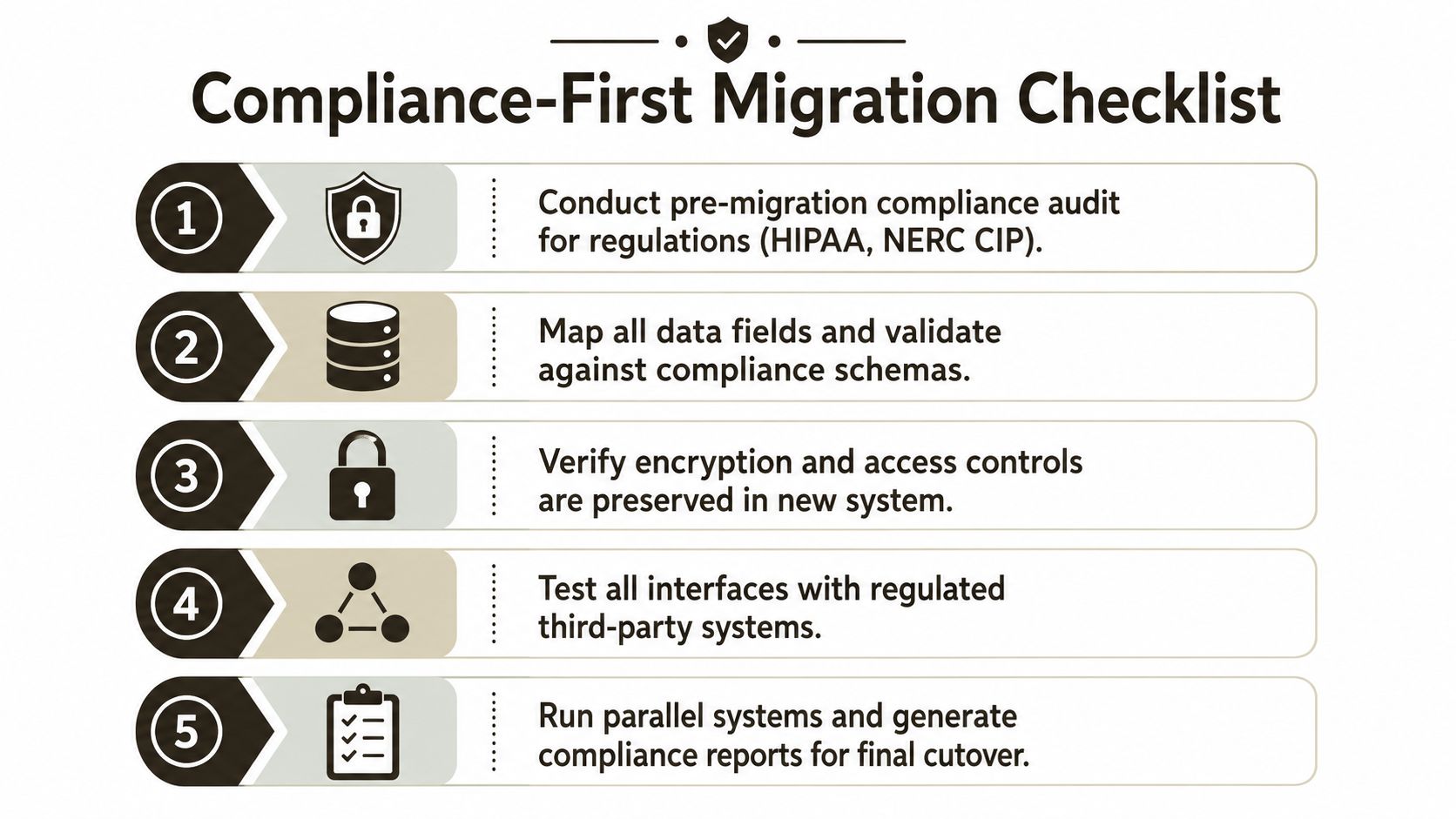
Missing a control doesn't merely delay the migration. In a regulated environment, it can break legal compliance, invalidate evidence, expose restricted data, or interrupt service delivery. The reward for disciplined design is a controlled transition. The alternative is paying to discover your assumptions in production.
The Risk Reduction Strategy for Complex Consolidations
SPMT has a place in bounded, predictable migrations. It can support straightforward workloads where the source structure, permissions, paths, and content behaviour fit the target. It isn't the tool I would put in charge of a complex tenant-to-tenant consolidation involving regulated supply chain data, fragmented identities, high-volume libraries, and business-critical integrations.
ShareGate offers stronger operational control and useful migration visibility. It still won't replace discovery, information architecture, identity redesign, exception handling, or a tested rollback plan. A tool can move content correctly and still leave the organisation with broken inheritance, unresolved GUID conflicts, missing owners, or workflows that point to the wrong location.
Custom PowerShell PnP scripting provides the control required for analytics-critical datasets and unusual transformations. It also creates responsibility. Poorly written scripts can amplify throttling, duplicate records, mishandle retries, or make recovery difficult. Your team needs version control, logging, test data, idempotent operations, and someone who understands both the Microsoft 365 service limits and the supply chain process.
We often see clients fail when they treat migration as a file-copy exercise. The rescue work starts by restoring trust in the records, then rebuilding the identity model, correcting the information architecture, reconciling content, and proving the result to operational and compliance owners. Ollo handles complex Microsoft 365 and SharePoint consolidations using ShareGate and custom PowerShell PnP scripts, with attention to Entra ID zero-trust redesign and controlled rescue migrations. For a merger scenario, review this IT leader's guide to Microsoft 365 tenant consolidation.
Ollo Verdict: Use SPMT for a tightly bounded workload. Use ShareGate when its controls fit the migration. For complex tenant-to-tenant supply chain consolidations, use specialist-led discovery, custom scripting, governance, and rollback discipline. DIY is not a risk strategy.
The cost of failure is operational interruption, compliance exposure, and a second migration after users stop trusting the first one. Your team should engage Ollo before selecting a tool, not after the cutover has failed.
Ollo provides specialist Microsoft 365 and SharePoint migration services for supply chain data, including tenant-to-tenant consolidation, Entra ID zero-trust redesign, ShareGate delivery, custom PowerShell PnP scripting, and rescue migrations. Visit Ollo to discuss your architecture, migration risks, and the evidence you need before production cutover.