


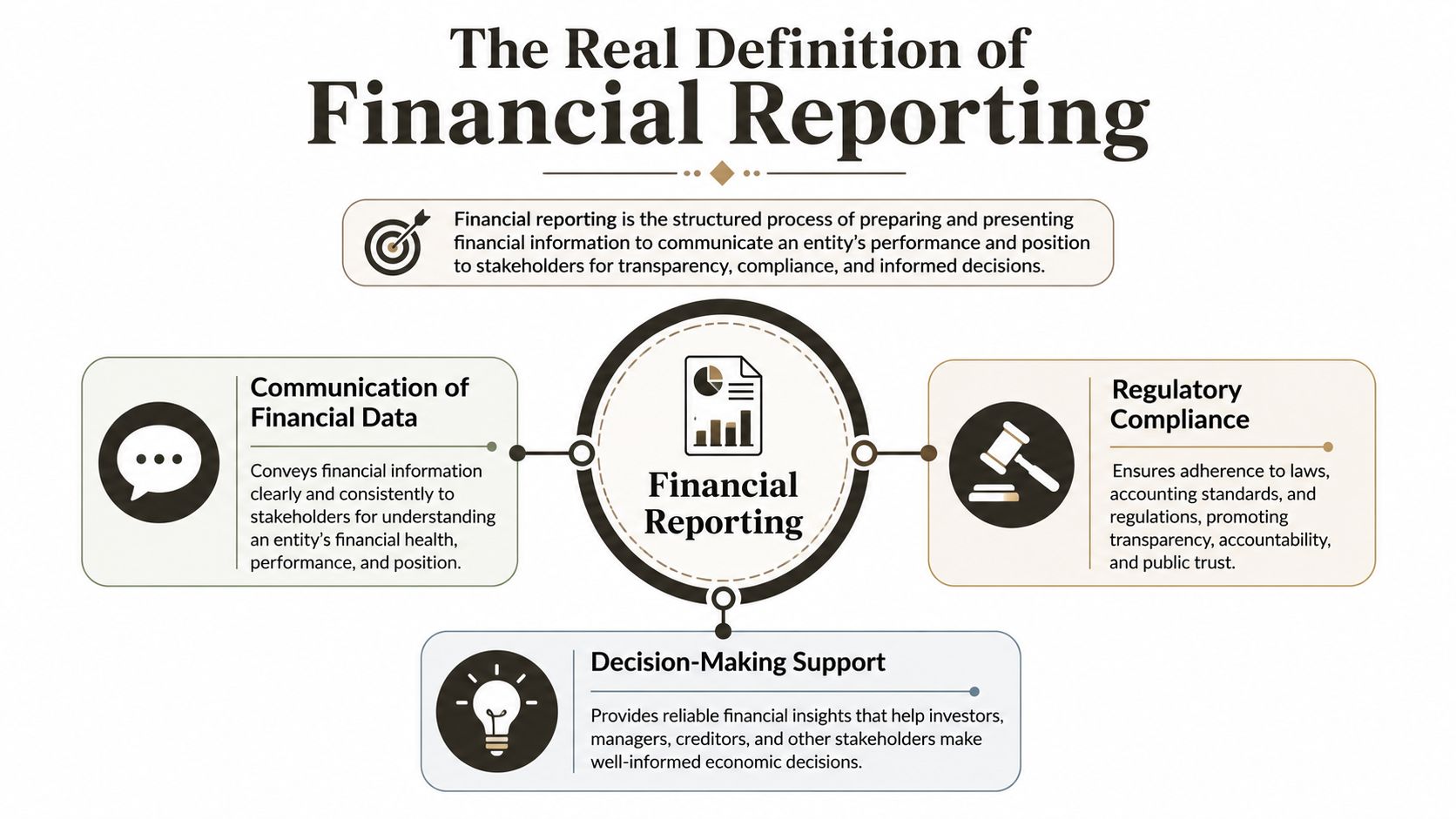
Financial reporting is the formal accounting process that compiles revenues, expenses, assets, liabilities, and cash flows into standardised statements, usually a balance sheet, income statement, cash flow statement, and a statement of changes in equity. It exists so stakeholders can assess performance and make resource-allocation decisions, not so finance teams can produce another spreadsheet.
If your board deck, audit pack, and ERP exports keep disagreeing, you're already dealing with a reporting pipeline problem, not a presentation problem. The numbers may look tidy on the last tab, but the control gaps usually start upstream, in classification, reconciliation, and change management.
Defining Financial Reporting Beyond the Textbook
The first failure mode shows up fast in the room and is hard to clean up after the meeting. Someone asks why the board pack says one thing, the trial balance says another, and the audit team wants support that nobody can pull together without searching email threads and local files. At that point, what is financial reporting stops being a textbook question and becomes a governance problem.
Financial reporting is the controlled process that turns operational transactions into standardised statements that people outside the finance team can rely on. The core outputs are the balance sheet, income statement, cash flow statement, and often the statement of changes in equity. Those documents are not decorative summaries, they are the governed record of where the money came from, where it went, and where it stands at a point in time, which is the logic reflected in standard financial statement guidance and broader analysis of statement relationships (financial statement analysis overview).
Why the definition matters in practice
The definition matters because the audience is never just finance. Shareholders, lenders, management, regulators, and investors all read the same package with different questions in mind. If the output is inconsistent, the failure does not stay in finance, it spills into board assurance, financing conversations, and statutory filing discipline.
Practical rule: if your team cannot trace a number from the general ledger to the final statement without manual patchwork, the reporting process is already compromised.
That is why a clean PDF proves very little. The useful work sits upstream in reconciliations, classification rules, approval paths, and change control. If you need to see how a reporting layer presents data while still depending on source discipline underneath, the guide on Power BI for business is a useful reference.
For teams that need a practical benchmark on lender conversations, the resource on securing funding with accurate reports is useful because it treats reports as decision tools, not as accounting theatre.
Breaking Down the Core Financial Statements
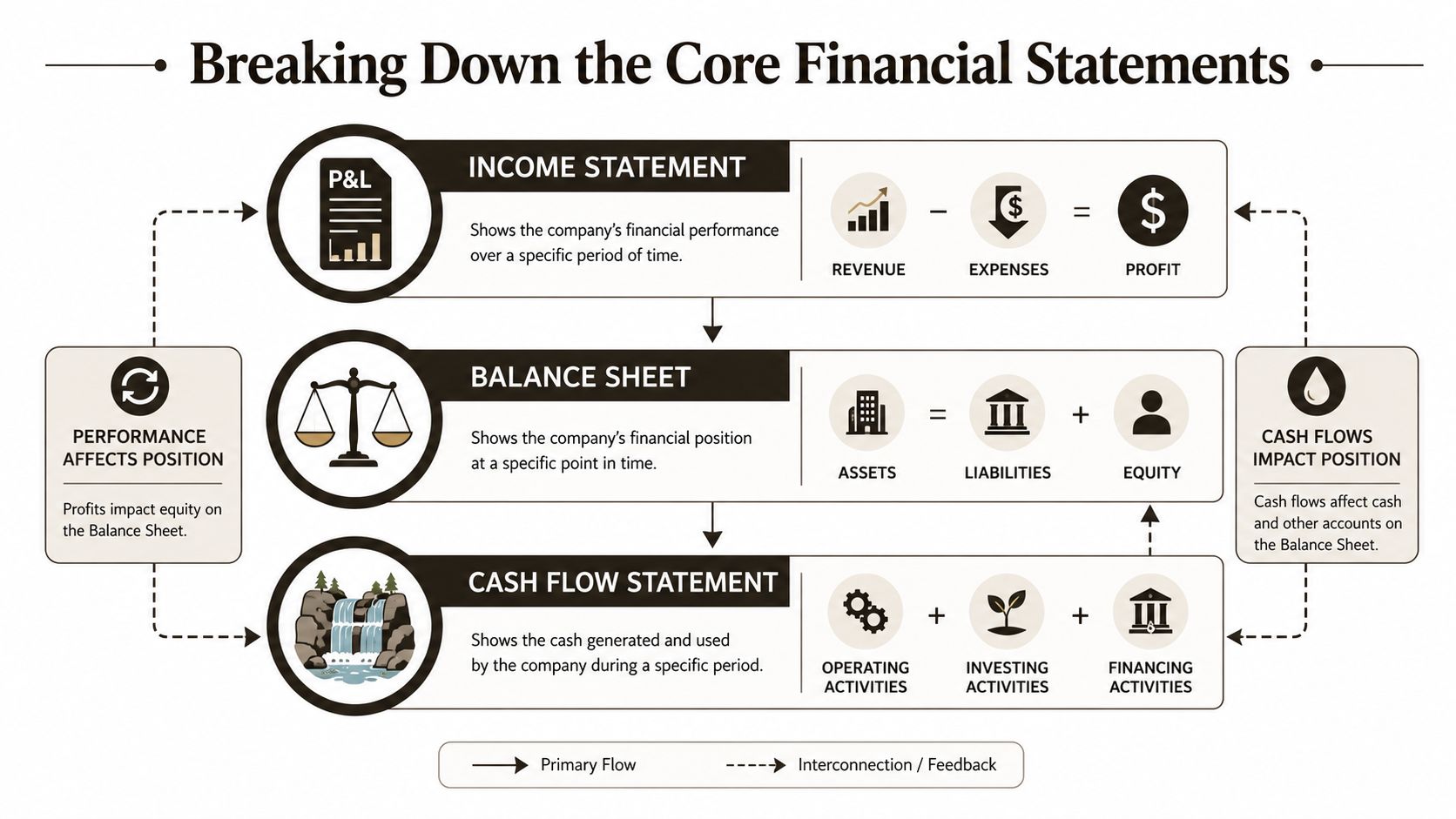
The core statements work together. If your team treats them as separate deliverables, you'll miss the mismatch between profitability, net assets, and cash movement, and that's where review meetings go sideways.
The balance sheet shows position
The balance sheet is a snapshot at a point in time. It shows assets, liabilities, and equity, so it answers a simple question, what does the organisation own, what does it owe, and what is left for owners after obligations?
That snapshot only works if upstream balances are current and classifications are consistent. A stale receivables sub-ledger, a mis-tagged liability, or a manual journal posted to the wrong class can make the statement look tidy while hiding a real exposure that surfaces later in audit review.
The income statement shows performance
The income statement tracks revenue and expenses over a defined period, so it answers a different question, how did the organisation perform during that period? It is the report people often overtrust because profit looks decisive on paper.
That's dangerous. A business can show profit and still run into liquidity pressure if collections lag or spending timing shifts. The accounting narrative may look strong while the operational reality feels tight, which is why finance leaders should never read profit in isolation.
The cash flow statement shows movement
The cash flow statement closes the loop. It groups cash movement into operating activities, investing activities, and financing activities, and it reconciles ending cash with the balance sheet, which is why it matters when profit and cash disagree.
One source on financial reporting mechanics notes that the statement may use either the direct or indirect method for operating cash flows, and that distinction matters because the indirect method starts with net income and adjusts for non-cash items, while the direct method shows actual cash movement more plainly (how to create a financial report). If you're explaining this to a leadership team, the point is not academic. It's the difference between a business that looks healthy and a business that can pay suppliers, payroll, and debt service.
The statements are complementary, not interchangeable. One tells you position, one tells you performance, and one tells you liquidity.
An internal guide on records management is relevant here because weak record retention almost always shows up later as mismatched supporting evidence, not as a neat finance error.
Stakeholders and Compliance Requirements
Financial reporting exists because other people rely on it for decisions they cannot afford to get wrong. Shareholders want a view of value and stewardship. Lenders want confidence around repayment and covenant risk. Management wants a reliable operating picture. Regulators want consistent disclosure. Investors want comparable information that helps them assess resource allocation.
The IFRS Conceptual Framework says the objective of general purpose financial reporting is to provide information that helps investors, lenders, and other creditors make resource-allocation decisions by assessing assets, liabilities, equity, income, expenses, and future net cash inflows (IFRS Conceptual Framework). That is the standard to keep in view when someone treats reporting as a formatting choice inside finance. It is a decision-support system with legal and contractual consequences, and the data pipeline behind it has to behave like one.
Ireland and the wider compliance frame
In Ireland, the Companies Act 2014 sets the filing and disclosure framework for company accounts. The wider UK and Ireland reporting environment also runs at scale, which is why structured reporting discipline matters. This is not a niche finance task handled by one analyst at quarter-end.
Ireland's listed groups also work within IFRS as adopted by the EU for consolidated financial statements, and that changes how teams think about controls, comparatives, and disclosure discipline. The reporting stack has to match the governing framework, not a local spreadsheet habit. In practice, the weak point is often not the accounting rule itself, but the way data is classified, retained, and handed off between finance and IT.
For a regulated-sector view of that issue, the internal note on Microsoft 365 financial services compliance shows why auditability and retention controls sit beside the accounting rules, not underneath them. When collaboration files, approval trails, and version history are scattered across tools, finance loses the evidence it needs when auditors ask how a number was produced.
Why reliability depends on the framework
A technical review in The Hindu BusinessLine makes the point plainly, financial statements are only considered accurate and reliable when the records align with the established accounting framework, legal requirements, accounting standards, court rulings, and regulator directives such as those from IRDAI, RBI, and SEBI (technical review of financial reports). That means arithmetic accuracy is not enough.
If recognition, measurement, or disclosure diverges from the framework, the statement can still be unreliable even when the totals add up. That is the part many IT and finance teams miss when they assume controls are only about access and approvals. They are also about whether the data model matches the rule set, whether approvals happen on the right version, and whether the audit trail survives review.
Compliance does not start at sign-off. It starts in the source system, where classifications and transformations either preserve the framework or corrupt it.
An additional practical angle on controls is log discipline. The guide on log management HIPAA and SOC2 is useful because auditability depends on evidence, and evidence depends on logs that survive review.
Where Financial Reporting Actually Breaks Down
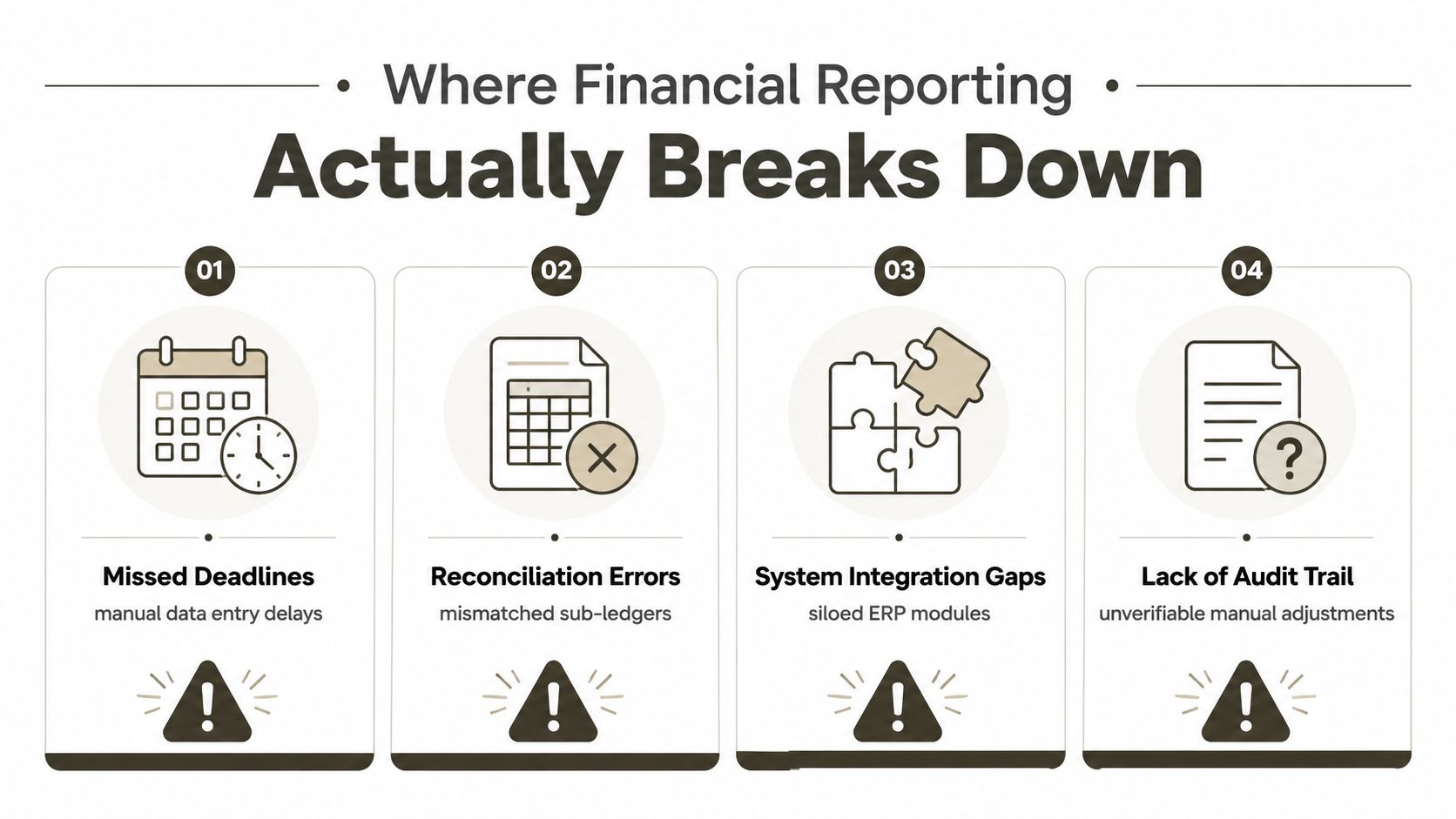
The overconfident version of this problem says finance just needs to “close faster.” That misses the point. Reports go wrong because teams miss reconciliations, apply inconsistent accounting policies, or sign off numbers before review controls are complete.
The usual failure pattern
The first break is often boring. A sub-ledger doesn't tie out, a manual adjustment lands in the wrong period, or a reviewer approves a pack without checking whether the supporting schedules reflect the latest classification rules. The result is not just a messy workbook. It's a report that can mislead lenders, frustrate auditors, and weaken board confidence.
The Longwood overview on common financial statement mistakes calls out missed reconciliations, inconsistent policies, and weak review controls as recurring causes of bad reporting outcomes (financial statement mistakes). That lines up with what breaks in the field. Teams often think they have a reporting issue when they really have a control issue.
What bad controls do to the close
Late statutory reporting rarely arrives alone. It usually travels with audit friction, unresolved balance-sheet items, and a board pack that looks complete but can't be defended line by line. In regulated environments, those failures can cascade into covenant problems and publication delays, which is why the gap between “numbers compiled” and “numbers trusted” matters so much.
The biggest mistake is treating financial reporting as a PDF output problem. The primary control point sits upstream in the general ledger, the mapping rules, the approval chain, and the evidence trail that proves each number belongs where it landed.
The reporting guide at content governance is relevant because financial statements depend on the same discipline, version control, ownership, and publication gating that any governed content does.
Here's the blunt version:
- Missed reconciliations create silent variance that later becomes an audit exception.
- Inconsistent accounting policies make comparable periods untrustworthy.
- Weak publication review lets incorrect statements leave the finance team.
- Broken data lineage makes the final number hard to defend.
If your process depends on a single person remembering what changed and why, you don't have a reporting process. You have a memory test.
The IT Systems Problem Behind Reporting Failures
Financial reporting problems often look like accounting issues on the surface and infrastructure issues underneath. Once data lives across SharePoint, ERP exports, file shares, and migrated document libraries, the reporting trail becomes only as strong as the weakest system boundary.
Migration damage shows up later in finance
A SharePoint migration, a Tenant-to-Tenant consolidation, or a legacy system shutdown can break the lineage between source data and final reporting packs. The file may still open, and the totals may still calculate, but the audit trail can collapse if metadata, versions, or permissions don't survive the move. When that happens, finance doesn't just lose convenience. It loses traceability.
The technical risk is not hypothetical. Microsoft Learn documents the realities behind API throttling, list view thresholds, long path limits, and related platform constraints, and those limits matter when teams move large document sets or poorly structured libraries. Microsoft's documentation also covers how SharePoint permissions and inheritance behave, which is where many migrations fail once business data and security rules meet at scale. If you want the business-side implications, the internal page on finance SharePoint migration explains why document control and financial control are the same problem in a regulated setup.
What breaks in real projects
We often see clients fail when they assume migration tools preserve meaning, not just files. Broken inheritance can expose confidential working papers. GUID conflicts can confuse references. List view threshold issues can block validation at the exact moment a team tries to confirm completeness. Long path limits can leave files behind without an obvious error in the finance pack.
That's why a failed migration doesn't just create IT noise. It can invalidate the evidence needed for audit, weaken legal compliance, and trigger remediation work after the business has already signed off the reporting cycle. In regulated sectors like finance, healthcare, and energy, that cost is not abstract.
The migration is never just a storage move. It's a control-preservation exercise, and the control evidence has to survive every handoff.
When teams decommission a legacy platform without preserving the reporting context, they create gaps that show up later as missing support, unexplained adjustments, or a reporting package no one can confidently defend. That's why IT architecture and financial reporting belong in the same conversation.
Why DIY Reporting and Migration Is a High-Risk Strategy
The documentation for basic tools makes migration look manageable. In reality, enterprise reporting environments punish shortcuts. SPMT can be fine for limited, straightforward moves, but once you're dealing with complex permissions, metadata fidelity, large libraries, or regulated financial records, the tool stops being the deciding factor. The process design becomes the risk.
Where basic tools stop being enough
The common failure is assuming a copy job equals a controlled migration. It doesn't. A tool might move files, but it won't automatically fix inconsistent classification, validate every permission edge case, or reconstruct the audit trail the business needs later. ShareGate is stronger in enterprise scenarios, but even then, the difficult cases still demand careful scripting, validation, and exception handling.
The problem grows when teams rely on manual wraparound work to compensate for platform limits. That's how metadata gets dropped, inheritance gets broken, and review evidence gets scattered across temporary folders and one-off spreadsheets. The documentation says the platform supports the move, but reality is messier once you hit regulated data, legacy structures, and complex reporting ownership.
Why the cost of failure is bigger than the project
Missing a control step doesn't just delay a migration. It can break legal compliance, distort financial reporting, and force the business into rework during audit season. That's the trade-off teams underestimate when they try to save budget by keeping the process in-house.
Use SPMT for simple, low-risk moves. For anything that carries regulated financial evidence, you need specialist planning, migration validation, and a team that knows how to preserve control chains.
That's a key reason DIY is a bad bet. The organisations that handle sensitive reporting data can't afford partial success. They need a migration and controls strategy that treats evidence, lineage, and permission structure as first-class requirements, not afterthoughts.
Your Financial Reporting Controls Checklist
Strong reporting controls don't start with a prettier dashboard. They start with predictable rules that keep data clean before it reaches the statement pack. If your team wants fewer surprises at close, tighten the process here.
The controls that actually matter
- Document accounting policies clearly. If teams interpret recognition or classification differently, the report stops being comparable across periods.
- Standardise your classification framework. Every source system and report should map to the same language, or reconciliation turns into guesswork.
- Lock in reconciliation schedules with sign-off gates. Reviews need owners, deadlines, and evidence, not verbal assurance in a meeting.
- Preserve the audit trail end to end. Keep version history, approvals, and change records intact so auditors can follow the path from source to statement.
- Validate migration outputs before publication. Check permissions, file completeness, and metadata before the reporting pack goes live.
Technical safeguards for Microsoft 365 environments
Migration controls need a second layer. In SharePoint and Microsoft 365, verify permission inheritance, map metadata before cutover, test path length edge cases, and resolve GUID conflicts before users discover them in production. If a library structure can't survive migration unchanged, your reporting evidence is already at risk.
The operational lesson is simple. Controls are not admin overhead. They are the reason the numbers remain defendable under audit pressure.
If the evidence chain breaks, the report may still look finished, but it won't stand up when someone asks how the number was produced.
Use the checklist, test it against your actual system layout, and treat every exception as a control failure until proven otherwise. If you're running regulated reporting across Microsoft 365, file shares, and finance platforms, that discipline is the difference between a clean close and a cleanup project.
A CTA for Ollo. If your financial reporting depends on fragile migrations, inconsistent controls, or evidence you can't defend under audit, talk to Ollo about a safer path before the next close exposes the gaps.